
WEEKLY MARKET DIGEST • September 21 – September 28, 2026
TLDR
- Rates repricing dominated: US 10Y +19bp and 30Y +17bp, while the Nasdaq gained +2.06% for the week.
- Key catalysts: robust US data, strong economic-growth expectations, weak auction demand, sticky inflation concerns, and heavy Treasury issuance.
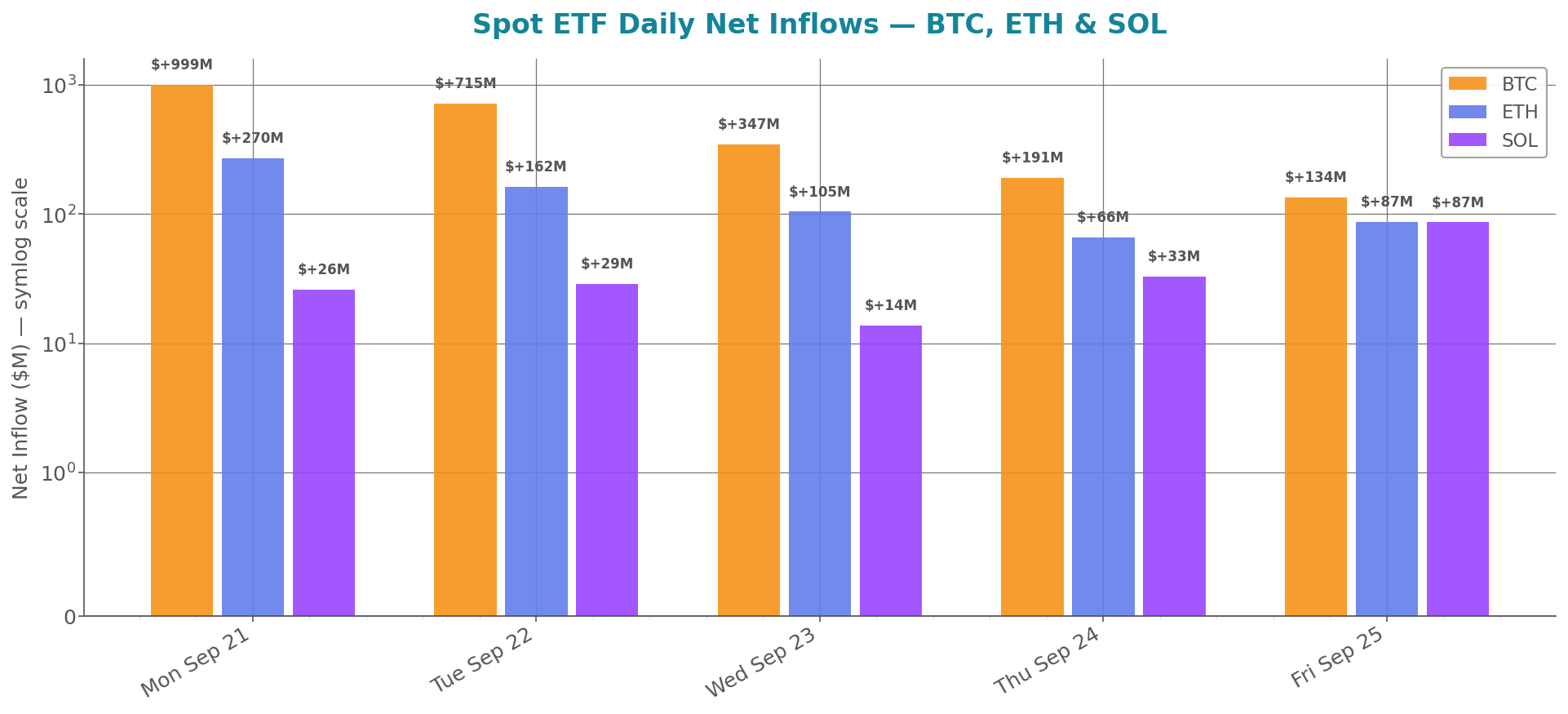
- US spot Bitcoin ETFs drew roughly $2.4 billion in weekly net inflows, taking cumulative net inflows to $57.6 billion.
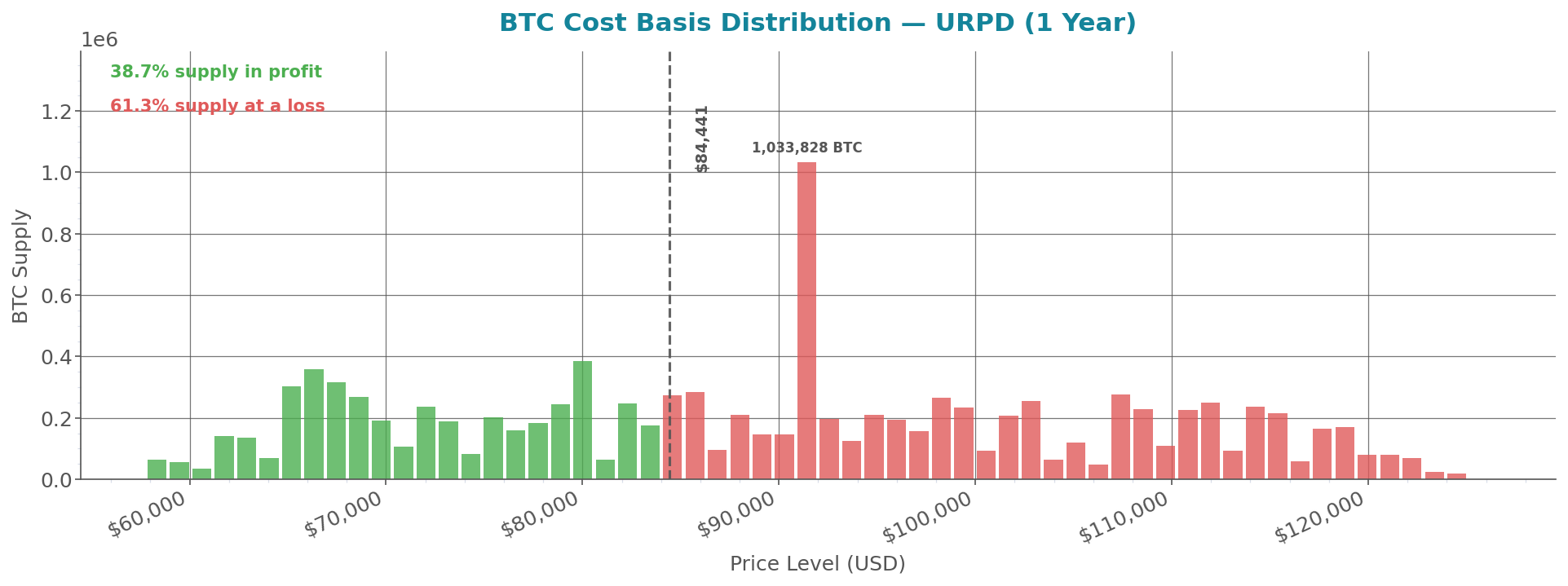
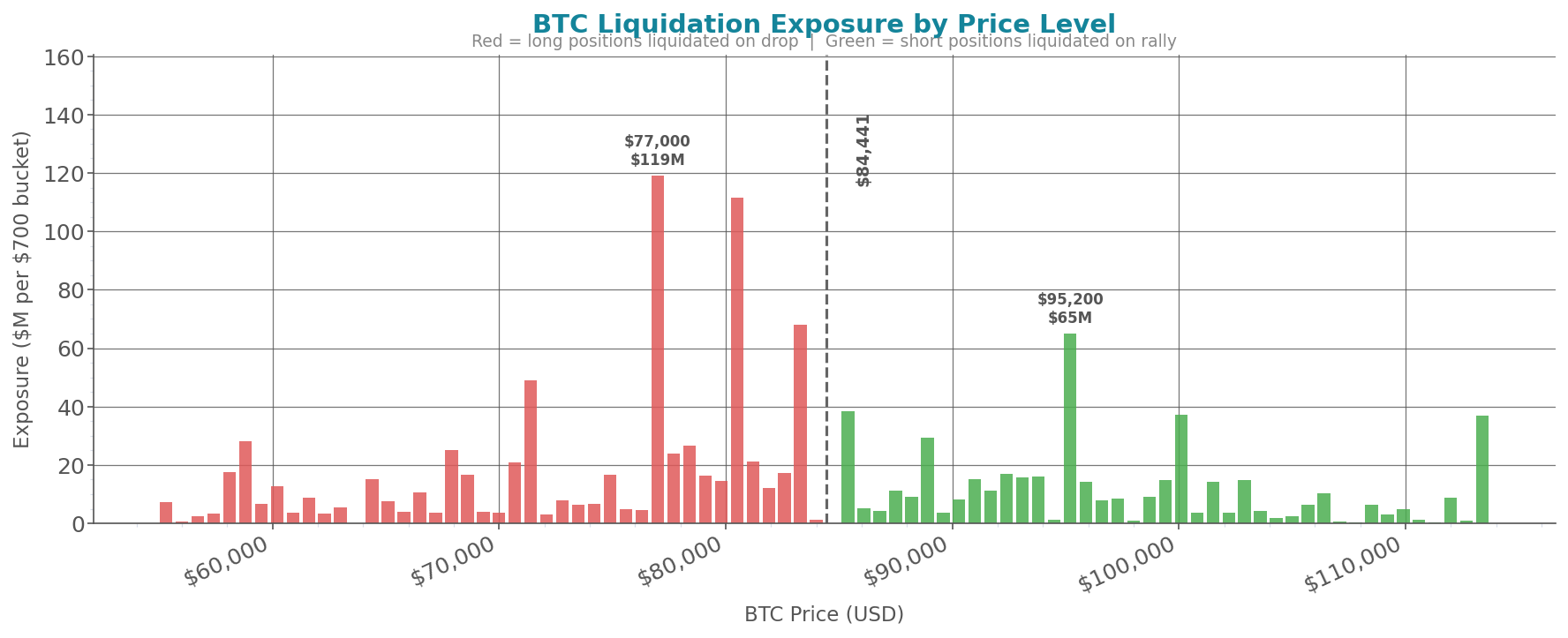
- BTC has slipped back below the $83,300 cost-basis/liquidation cluster; next support is the $82,663 level (~151,470 BTC concentrated there) — watch whether that holds or liquidations extend the pullback.
Weekly Market Performance
| Asset | Week Open | Week Close | Weekly Change | 1M Change |
|---|---|---|---|---|
| Global Crypto Market Cap | $2.80T | $2.85T | +1.60% | — |
| S&P 500 | 7,650.50 | 7,743.41 | +1.21% | +0.41% |
| Dow Jones | 51,682.64 | 51,828.62 | +0.28% | -3.23% |
| Nasdaq | 26,522.54 | 27,068.72 | +2.06% | +2.52% |
| VIX | 14.81 | 14.87 | +0.06pp | +0.44pp |
| Bitcoin (BTC) | $81,771 | $83,118 | +1.65% | +7.33% |
| Ethereum (ETH) | $2,669 | $2,650 | -0.70% | +8.92% |
Macro Highlights
US-Iran Tensions
US-Iran tensions remain unresolved, with Iran linking a potential reopening of the Strait of Hormuz to conditions including reduced US military pressure and the lifting of the US blockade. Iran proposed reopening the Strait within seven days if Washington met its conditions and indicated that negotiations could resume. President Trump subsequently rejected the proposal. Separately, Houthi forces continued attacks involving Saudi Arabia, adding to regional supply risks.
WTI crude fell 7.87% over the week to $92.41, as expectations of a potential US-Iran agreement and reopening of the Strait outweighed renewed supply-disruption concerns. The decline in oil prices eased some near-term inflation pressure, although the risk of renewed escalation remains relevant given the importance of the Strait to global energy flows.
(Bloomberg) (CNBC)
US-China Trade Talks
The US and China agreed to reduce tariffs on approximately $30 billion of non-sensitive goods in each direction and extended their existing trade truce until January 10, 2027.
Following the Trump-Xi summit, the two sides agreed on tariff reductions covering products including agricultural goods, wood products, cosmetics and medical devices on the Chinese side, and small appliances, toys, holiday decorations and children's car seats on the US side. The agreement also included continued discussions on AI and other trade issues.
(Financial Times) (Bloomberg) (CNBC)
Bond Market Volatility
The 10-year Treasury yield reached 5.18% intraday on September 24, its highest level since 2007, before closing the week at 5.17%. The 30-year yield closed at 5.49%, its highest level since 2004. The rise in long-term yields was part of a broader global bond-market sell-off, with Japanese government bond yields also reaching elevated levels.
(CNBC) (Bloomberg) (Financial Times)
Week ahead
- ISM Manufacturing (Oct 1): The September ISM Manufacturing PMI is scheduled for release at 10:00 ET. A weaker reading could reinforce concerns about manufacturing momentum, while a strong reading could support the current resilient-growth narrative.
- Nonfarm Payrolls (Oct 2): The September Employment Situation is due October 2. A weaker-than-expected labor-market report could affect expectations for monetary policy, Treasury yields and the dollar.
- Manufacturers' Shipments, Inventories and Orders, full report (Oct 2): The full durable-goods release lands the same day as payrolls; the August advance reading (released Sept 25) came in flat, so this fills in the revisions and the broader shipments/inventories picture markets didn't get from the advance print.
Crypto Highlights
California Governor Newsom has signed a law banning public officials from issuing memecoins, effective for tokens issued from January 1, 2027, which also restricts crypto companies from offering certain memecoins tied to public officials to California residents.
South Korea is reconsidering its approach to crypto market makers after JPYC traded at 4 times its peg on Upbit this month, despite crypto market making being effectively restricted under South Korea's manipulation rules.
Vitalik Buterin said that Hegotá, Ethereum's planned 2027 upgrade, is likely to be the network's last “normal” fork, with subsequent upgrades increasingly centered on recursive STARKs, automated formal verification, highly optimized consensus, and quantum-safe cryptography.
The Zano blockchain has been rolled back approximately a month after an exploit was discovered related to Gateway Addresses, which were introduced with Hard Fork 6, according to the details of the incident.
US Spot Crypto ETF Flows
| Fund | Weekly Net Flow | Cumulative Inflow | AUM |
|---|---|---|---|
| BTC Spot ETF | +$2,385.8M | +$57,568.1M | $108.42B |
| ETH Spot ETF | +$689.9M | +$13,939.9M | $17.78B |
| SOL Spot ETF | +$188.2M | +$1,605.3M | $1.96B |
Spot ETF Daily Flows — BTC, ETH & SOL
Cost Basis Distribution & Liquidation Exposure
BTC
ANALYST INTERPRETATION — BTC
1. Positioning & Derivatives Read
$284M of BTC perp shorts were liquidated this week versus $37M of BTC perp longs, making the week-total long/short liquidation ratio 0.13. BTC ETF demand ran in the same direction as BTC price, with $+2386M of weekly net inflows taking cumulative BTC ETF inflows to $57.6B against $108.4B of BTC ETF AUM. BTC gained +1.65% for the week. BTC looks under-extended rather than over-extended on realised perp liquidations, but the more exposed side into next week is the long side, with $437M of longs below BTC spot versus $152M of shorts above.
2. Key Risks & Levels for Next Week
Long Liquidation Cascade: BTC has broken below the $83,355 cost-basis support cluster (175,869.48 BTC held there) and the $83,300 level carrying $67.9M of long liquidation exposure, and now trades around $82,800, within roughly $175 of the next cluster at $82,663 (151,470 BTC). Whether that level holds is the immediate question: a break below it removes the last nearby support before the much deeper $80,589 cluster, while a bounce off $82,663 would mark this pullback as shallow.
Deeper Long Flush: $80,589 holds 281,717.30 BTC of cost-basis supply, and $80,500 carries $111.5M of long liquidation exposure. BTC risk would be playing out if BTC ETF flows turn negative while BTC spot volume expands on downticks and BTC perp liquidation rates rise before the $80,500 band is reached.
Short Squeeze Extension: $90,960 is the largest overhead cost-basis cluster, with 648,702.15 BTC held there, and $91,652 adds another 385,125.35 BTC of supply just above it. BTC upside risk is active if BTC ETF inflows remain positive while BTC spot volume lifts into the overhead supply and BTC options skew shifts toward calls before the $95,200 short-liquidation band with $65.1M of exposure.
ETH
ANALYST INTERPRETATION — ETH
1. Positioning & Derivatives Read
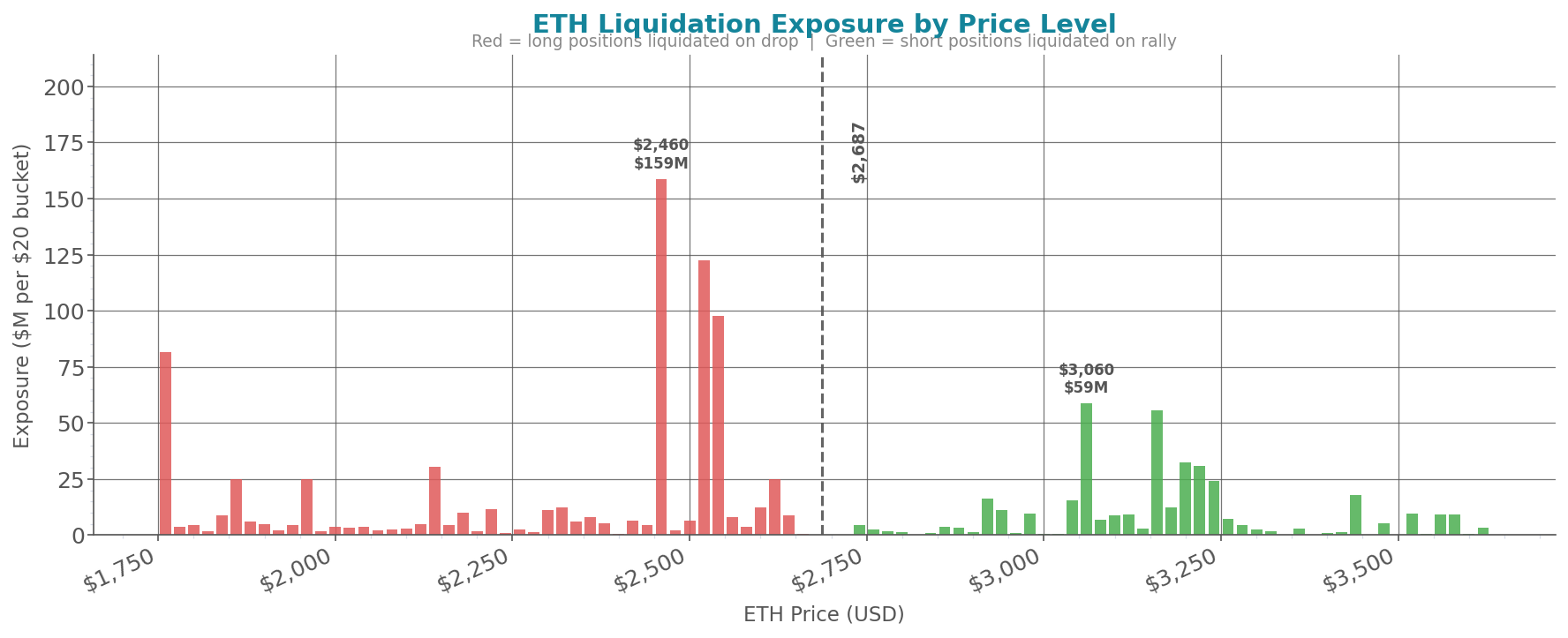
ETH perpetual futures positioning showed realised short pain first: $207M of ETH perp shorts liquidated versus $156M of ETH perp longs liquidated for the week. The ETH week-total long/short liquidation ratio was 0.75, while ETH still moved from $2,669 at the week open to $2,650 at the week close, a -0.70% weekly move. ETH ETF demand was positive, with $690M of weekly net inflows, so cash-product buying did not translate into a sustained upside extension in ETH price. ETH last-day perpetual liquidations flipped toward longs, with $11M of ETH perp longs liquidated versus $6M of ETH perp shorts liquidated, showing downside pressure was hurting late longs into the close. ETH is not over-extended to the upside; the long side is more exposed going into next week, with $457M of ETH long exposure within 10% below ETH spot versus $47M of ETH short exposure within 10% above ETH spot.
2. Key Risks & Levels for Next Week
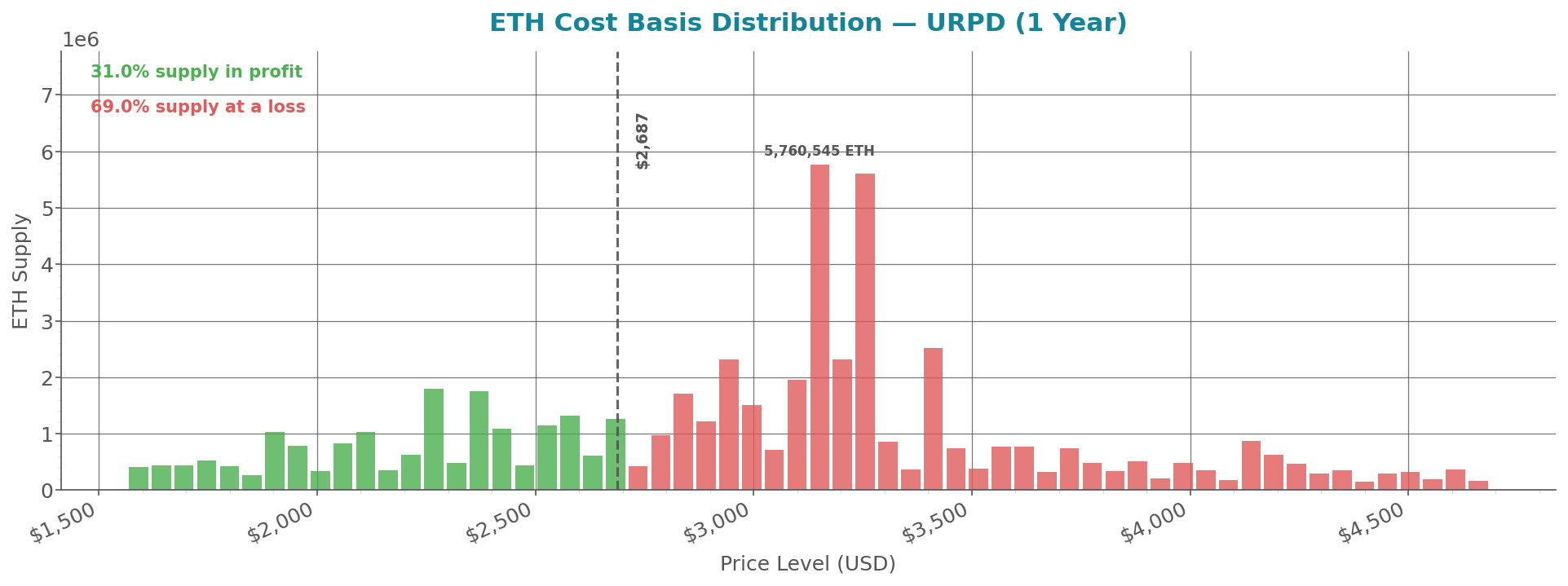
Long Liquidation Cascade: ETH has a cost-basis support cluster at $2,574 with 723294.01 ETH held there, and the liquidation map stacks $97.8M of ETH longs at $2,540 plus $122.4M of ETH longs at $2,520. The risk is that ETH spot selling into $2,574 turns from supply absorption into forced de-risking as the $2,540 and $2,520 long liquidation bands come into play. Watch ETH spot volume rising while ETH perp long liquidations accelerate, rather than waiting for a price close.
Deeper Downside Air Pocket: ETH has the larger below-spot cost-basis clusters at $2,385 with 1396339.72 ETH and $2,290 with 1511217.34 ETH, while $158.7M of ETH longs sit at the $2,460 liquidation level above those clusters. A failure of ETH demand before $2,460 would put the market into the heaviest nearby long-liquidation band and expose the larger holder base at $2,385 and $2,290. Watch for ETH ETF flows turning negative while ETH options skew shifts toward downside protection.
Short Squeeze Resistance: ETH has $58.6M of ETH shorts at $3,060 and $55.7M of ETH shorts at $3,160, with a much larger ETH cost-basis resistance cluster at $3,173 holding 5158779.56 ETH. The risk is that ETH upside momentum liquidates the $3,060 and $3,160 short bands but then meets heavy holder supply at $3,173. Watch ETH perp short liquidations rising alongside sustained ETH ETF inflows and spot volume expanding into the resistance zone.
On-Chain Signals — Bitcoin
| Signal | Week-End | Week Chg | Reading |
|---|---|---|---|
| MVRV Ratio | 1.644 | +13.6% | Moderate gains phase |
| NUPL | 0.402 | +25.8% | Optimism |
| Exch. Net Flow | -17,459.4 BTC | -17,735.4 BTC | Net outflows — accumulation |
| Exchange Balance (USD) | $285.89B | +13.8% | |
| Perp Funding Rate | +0.00363% | -0.00223pts | Near-neutral |
| Perp Open Interest | $39.66B | +16.7% | |
| 1M Implied Vol | 35.9% | -0.8pts | Low vol environment |
| 25Δ Put/Call Skew | 2.0% | -3.3pts | Neutral |
| Realized Vol (1W) | 48.7% | +22.6pts | Elevated |
| DVOL Index | 37.4 | -4.1% | |
| Accumulation Balance | 2,003,966 BTC | -0.4% | |
| Supply Held ≥100k BTC | 729,349 BTC | -2.0% | |
| Net Realized P/L | $+2,212.6M | +1862.0% | Coins moved at a profit |
Amber rows deviate >1.5σ from prior 4-week baseline • data as of 2026-09-22
MVRV at 1.644 and NUPL at 0.402 indicate meaningful but not extreme unrealized profitability, both up on the week (MVRV +13.6%, NUPL +25.8%). Derivatives positioning is elevated but not aggressively levered: perp OI is $39.66B, up 16.7% for the week and 5.4σ above baseline, while funding stayed near-neutral at +0.00363%, IV is 35.9%, and 25Δ skew at +2.0% shows mild downside demand. The key anomaly is $2.21B in net realized profit, 4.1σ above baseline, alongside -17,459 BTC in exchange net outflows — profit-taking that's being absorbed by continued exchange withdrawals rather than growth in accumulation-wallet balances, which held roughly flat on the week (-0.4%).
Weekly Market Wrap
Policy repricing defined the week: equities advanced, volatility barely moved, bonds sold off hard, and crypto split between Bitcoin accumulation and Ethereum fatigue. The S&P 500 rose 1.21% for the week, the Nasdaq rose 2.06%, and the Dow rose 0.28%, while the VIX was essentially unchanged at VIX +0.06pp. That calm surface masked a sharp rates adjustment, with the US 10y +19bp, 5y +15bp and 30y +17bp, as robust US economic data, weak auction demand, sticky inflation concerns and heavy issuance pushed long-term borrowing costs to their highest levels in nearly two decades.
Growth names carried the week while banks sat it out. Intel was the standout, up 13.26%, with Microsoft (+4.53%), Tesla (+2.15%), Apple (+1.47%) and Nvidia (+1.26%) all higher, a clear tilt toward semiconductors and growth over broad cyclicality. The banks told the opposite story: JPMorgan, Bank of America and Goldman Sachs all slipped, down roughly 0.7-1.9%.
Politics did some of the lifting. The US and China extended their trade truce, moved to detail product lists for a $30 billion tariff-cut plan, and agreed to an AI dialogue, though the Trump-Xi summit itself produced little in the way of structural concessions. Europe and Asia were mixed rather than directional: the Swiss Market, AEX, IBEX and DAX all edged higher, Tokyo's TOPIX ETF gained near 1%, while Hong Kong and Copenhagen both lost ground.
Elsewhere, the dollar firmed (DXY +0.75%, EUR/USD -0.65%, USD/JPY +1.72%), gold slid 2.34%, and oil was the week's biggest mover, WTI crude down 7.87% even as Trump's rejection of Iran's Strait of Hormuz proposal kept Middle East tension in the headlines.
Bitcoin finished higher but well off the most enthusiastic intraweek narrative, rising 1.65% from $81,771.38 to $83,117.75 after news flow had put it above $87,000 earlier in the week. Ether fell 0.70% to $2,650.33, while Solana rose 6.89% to $118.79, helped by ecosystem-specific momentum including ZetaChain holders approving a migration of ZETA to Solana and new Solana Foundation partnership hires. The week also delivered a dense regulatory tape: the Fed proposed stablecoin issuer rules including capital requirements and a two-day redemption window under the GENIUS Act, the CFTC updated guidance on tokenized assets and blockchain records, and New York sued Polymarket over alleged illegal gambling. Security risks were also prominent, with Bitget's breach rising to approximately $388 million.
Next week's macro focus is whether the US-China $30 billion tariff-cut implementation can hold alongside China's weakest industrial profit growth of the year, reported at 4.2% for August. Rates also remain central after the 10y +19bp weekly move and a 5s30s curve at +50bp, with auction demand, Fed communication and Treasury supply likely to matter more than index-level momentum. In crypto, attention turns to the Fed's stablecoin rulemaking process, the fallout from the Bitget exploit and related address-handling decisions, and SEC continuity as Hester Peirce is set to leave her post on October 2.