
WEEKLY MARKET DIGEST • September 07 – September 14, 2026
TLDR
- S&P 500 fell 0.22% to 7,656.98
- VIX rose 0.54pp to 15.84
- Bitcoin fell 2.84% to $77,440
- 10y yield rose 17bp to 4.97%
Weekly Market Performance
| Asset | Week Open | Week Close | Weekly Change | 1M Change |
|---|---|---|---|---|
| Global Crypto Market Cap | $2.71T | $2.64T | -2.39% | — |
| S&P 500 | 7,673.52 | 7,656.98 | -0.22% | -1.65% |
| Dow Jones | 52,786.07 | 52,573.29 | -0.40% | -2.16% |
| Nasdaq | 26,421.41 | 26,333.04 | -0.33% | -1.48% |
| VIX | 15.30 | 15.84 | +0.54pp | +1.59pp |
| Bitcoin (BTC) | $79,706 | $77,440 | -2.84% | +22.93% |
| Ethereum (ETH) | $2,502 | $2,512 | +0.39% | +33.69% |
Macro Highlights
Fed Rate Hike
The core CPI print came in at 2.45% y/y, above expectations, and the all-items consumer price index rose 0.4% in August, leading to a surge in Treasury yields. The market now prices in a higher likelihood of a Fed rate hike, with the 10Y yield at 4.97%. Higher crude prices, up 7.55% on the week, feed the inflation persistence argument, making a rate hike more likely, which would further increase the 10Y yield.
(Financial Times) (Nasdaq) (The New York Times) (Bloomberg)
Iran War Escalation
Oil supply risks remain elevated, with WTI crude at $100.05. Saudi Arabia shut its East-West pipeline after multiple attacks, and a vessel was struck in the Strait of Hormuz, threatening oil exports and escalating tensions. The oil price surge, with WTI up 7.55% on the week, will continue to pressure the inflation outlook, making a Fed rate hike more likely, and supporting the dollar index, which rose 0.28% on the week.
Trade War Intensifies
The trade war between the US and Canada has deepened, with Canada imposing tariffs of 15% to 50% on hundreds of US products. Canada's retaliatory tariffs worth CA$27.6 billion took effect, and Trump called for a boycott of Bombardier, escalating tensions. The trade war will continue to weigh on risk appetite, as evidenced by the VIX rising 0.54pp to 15.84, and may lead to further dollar strength, as investors seek safe-haven assets.
(CNBC) (Financial Times) (Bloomberg)
Energy Crisis Deepens
Supply chains remain disrupted, with oil prices near record highs. China set a goal for 70% of new cars to be electric vehicles or hybrids by 2030, and oil traded near $107 a barrel as fighting between Yemen-based Houthi militants and Saudi-backed forces intensified. The energy crisis will continue to drive inflation higher, with the core PCE price index at 3.34% y/y, and may lead to further increases in the 10Y yield, as the market prices in higher inflation expectations.
(CNBC) (Financial Times) (Bloomberg)
Week ahead
- Wed Sep 16: Advance Monthly Sales for Retail and Food Services — a softer-than-expected print would weaken the consumption outlook and could reopen the cut trade.
- Thu Sep 17: New Residential Construction — a weaker-than-expected reading would weigh on the growth outlook and could reinforce expectations for easier policy.
- Fri Sep 18: G.17 Industrial Production & Capacity Utilization — a stronger-than-expected print would support a firmer growth outlook and a more hawkish rate path.
Crypto Highlights
Revolut, a fintech company, is facing a critical data breach as attackers have published identity documents and selfies belonging to its customers and are threatening to release more data each day until the company pays.
Nasdaq invested $100 million in Payward, the parent company of Kraken, at a valuation of $21 billion, as part of its efforts to develop tokenized stock products with 24/7 trading capabilities.
US Republicans have sent a 'final' 635-page revised proposal of the CLARITY Act to Democrats, which includes Trump-backed ethics provisions, just two days before a key procedural vote is set to take place.
Robinhood CEO Vlad Tenev stated that issuers should not have veto power over tokenized stocks, suggesting that their involvement is only necessary when tokenized products alter shareholder rights or company obligations.
Liquid Network has resumed block production after an exploit resulted in a $320M loss, with the network deploying emergency software updates to address the issue, although transactions and peg operations remain suspended as recovery efforts continue.
Cost Basis Distribution & Liquidation Exposure
BTC
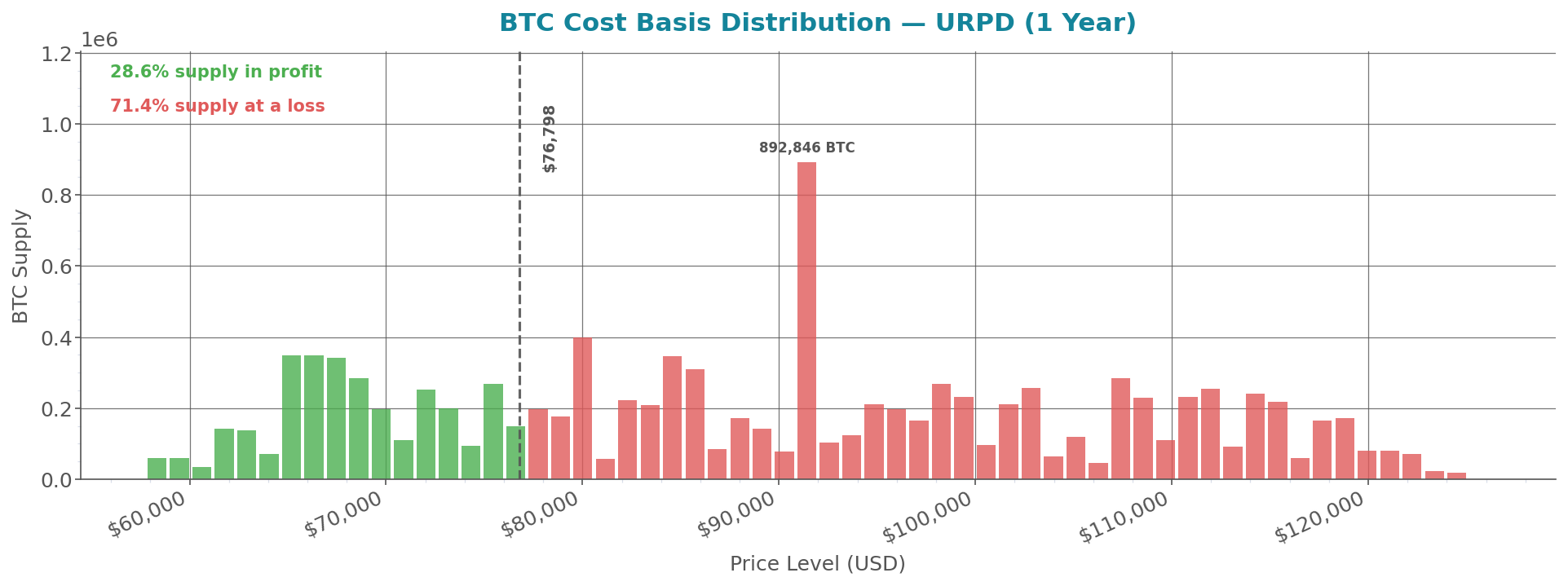
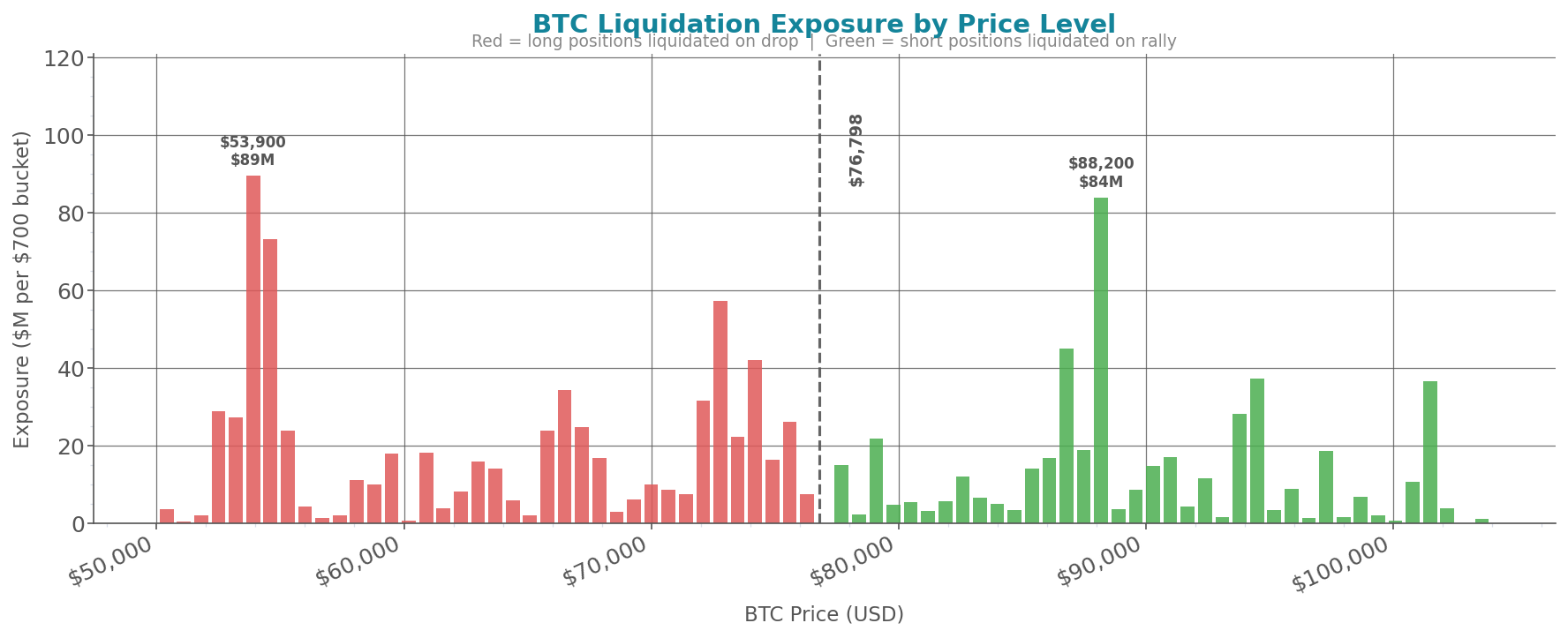
ANALYST INTERPRETATION — BTC
1. Positioning & Derivatives Read
The data indicates that longs were more heavily liquidated than shorts, with $223M of BTC perp longs liquidated compared to $98M of shorts, resulting in a long/short liquidation ratio of 2.28. The ETF flow direction and magnitude show a weekly net outflow of $463M, indicating a decrease in demand for BTC. Given the liquidation exposure clusters in the data, the market is under-extended, and the long side is more exposed going into next week, with $235M of longs at risk below BTC spot.
2. Key Risks & Levels for Next Week
Short Squeeze Risk: The largest supply cluster above current BTC price sits at $80,589 with 299,556.44 BTC, which could act as resistance and trigger a short squeeze if breached. A surge in spot volume on the way up would be a tell that this risk is playing out.
Long Liquidation Risk: The largest cost basis cluster below BTC spot sits at $75,057 with 172,346.88 BTC, and a breach of this level would push $42.0M of open longs underwater and into the highest liquidation exposure band in the heatmap. Watch for spot volume accelerating on the way down, not after, as the tell that this risk is unfolding.
Cascade Risk: The liquidation heatmap shows $235M of longs at risk below BTC spot, with the largest cascade level at $74,200, where $42.0M of longs would be liquidated. If BTC spot breaks down, a rapid increase in liquidation rate would indicate that this risk is materializing.
ETH
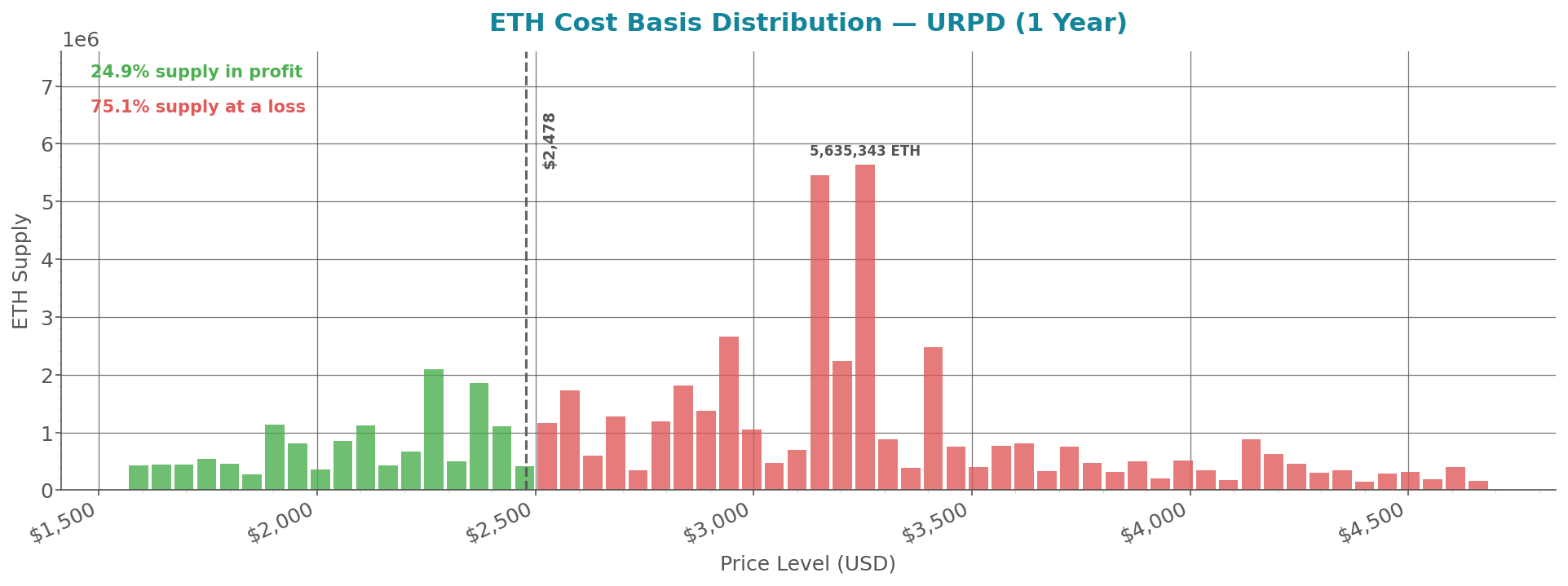
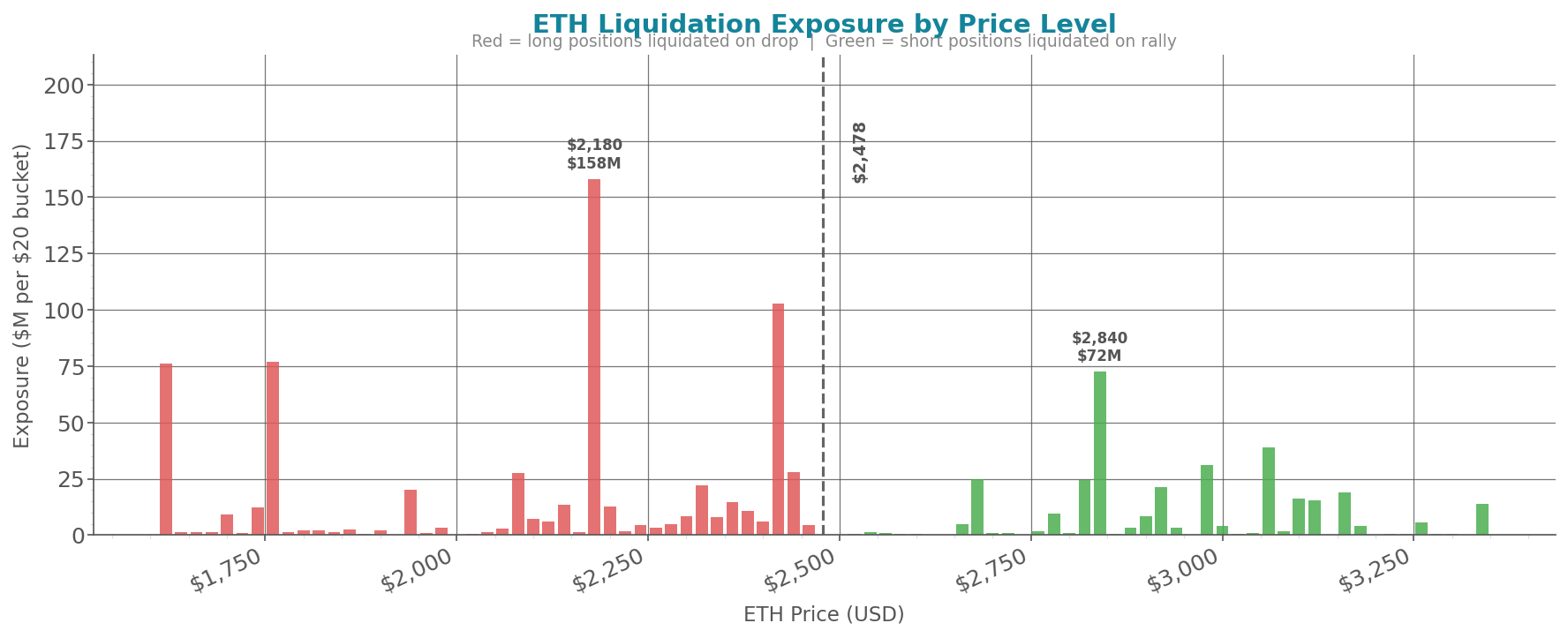
ANALYST INTERPRETATION — ETH
1. Positioning & Derivatives Read
The ETH market saw $194M of longs liquidated and $155M of shorts liquidated, with a long/short liquidation ratio of 1.25, indicating more longs were liquidated than shorts this week. The ETF flow direction was positive, with a weekly net flow of $+197M into ETH. Given the liquidation data and the exposure within 10% of ETH spot, where $218M of longs are exposed below spot and $36M of shorts are exposed above spot, the market is under-extended and the long side is more exposed going into next week.
2. Key Risks & Levels for Next Week
Liquidation Risk: The largest long liquidation exposure below ETH spot sits at $2,420 with $102.9M of longs, and a breach of this level would push more longs underwater and into the highest liquidation exposure band in the heatmap. Watch for ETH spot volume accelerating on the way down, not after, as this would be the tell that the risk is playing out.
Short Squeeze Risk: The largest short liquidation exposure above ETH spot sits at $3,460 with $240.1M of shorts, and a rally to this level would put significant pressure on shorts and potentially trigger a short squeeze. Monitor ETH options skew shifting as a sign that the market is pricing in this risk.
Support Break Risk: The top supply cluster below current ETH price is at $2,416 with 707042.96 ETH, and a drop to this level would test the resolve of longs and potentially lead to a cascade of liquidations. Look for ETH spot volume surging as the price approaches this level, indicating that the risk is materializing.
US Spot ETF Flows
| Fund | Weekly Net Flow | Cumulative Inflow | AUM |
|---|---|---|---|
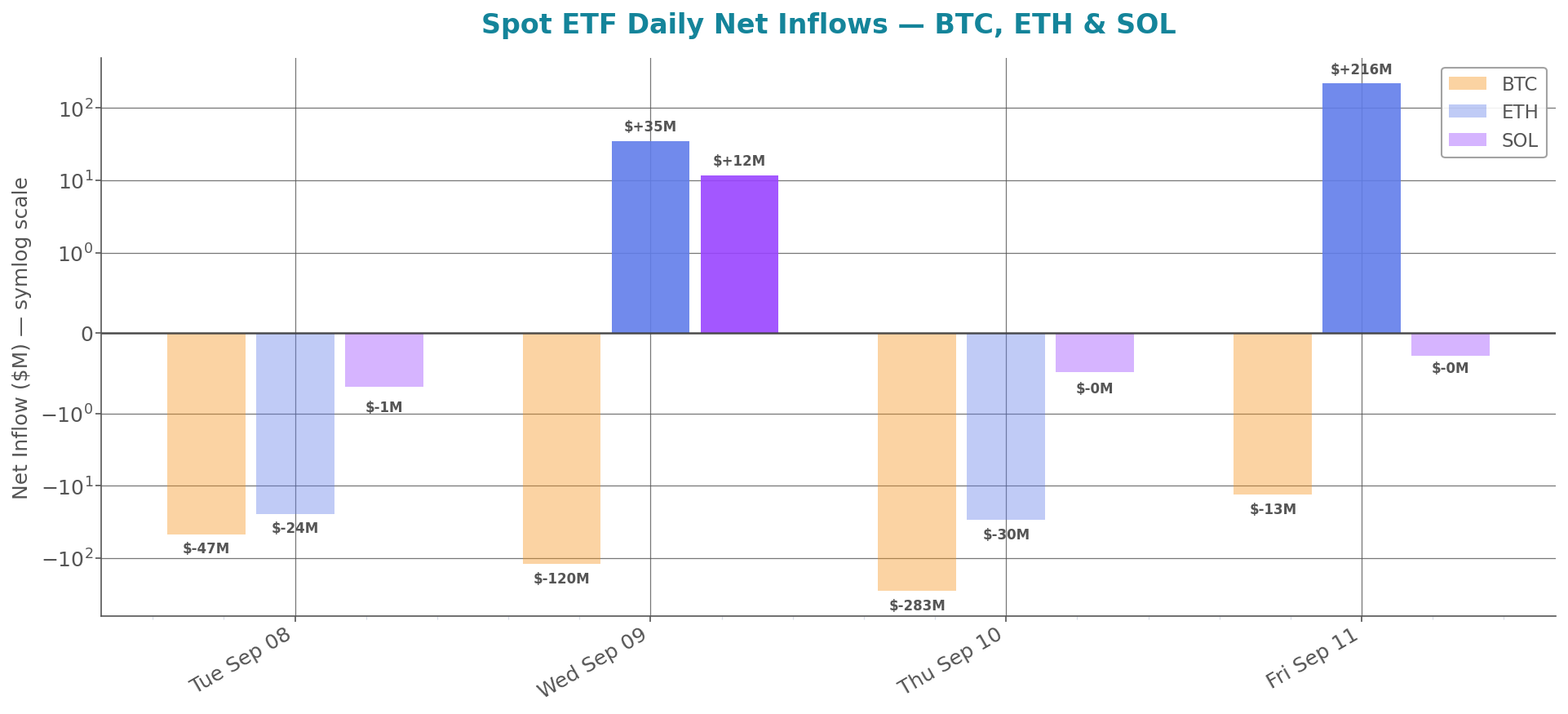
| BTC Spot ETF | $-462.7M | +$55,176.1M | $97.58B |
| ETH Spot ETF | +$197.1M | +$13,390.0M | $16.31B |
| SOL Spot ETF | +$10.3M | +$1,356.3M | $1.42B |
Spot ETF Daily Flows — BTC, ETH & SOL
On-Chain Signals — Bitcoin
| Signal | Week-End | Week Chg | Reading |
|---|---|---|---|
| MVRV Ratio | 1.470 | -3.0% | Fair value zone |
| NUPL | 0.330 | -5.8% | Optimism |
| Exch. Net Flow | -2,345.6 BTC | -2,912.8 BTC | Net outflows — accumulation |
| Exchange Balance (USD) | $254.80B | -2.8% | |
| Perp Funding Rate | +0.00605% | +0.00490pts | Near-neutral |
| Perp Open Interest | $34.00B | -2.3% | |
| 1M Implied Vol | 36.6% | -0.1pts | Low vol environment |
| 25Δ Put/Call Skew | 4.1% | +4.2pts | Neutral |
| Realized Vol (1W) | 16.7% | -20.8pts | Low realized vol |
| DVOL Index | 38.89 | +0.3% | |
| Accumulation Balance | 2,014,006 BTC | +0.1% | |
| Supply Held ≥100k BTC | 738,518 BTC | +0.0% | |
| Net Realized P/L | $+45.9M | -61.3% | Coins moved at a profit |
Amber rows deviate >1.5σ from prior 4-week baseline • data as of 2026-09-13
Weekly Market Wrap
This week saw a sharp rise in US Treasury yields, with the 10-year yield reaching 4.97%, its highest level since 2023, as investors reassessed the inflation and monetary-policy outlook. Renewed inflation concerns, elevated oil prices and expectations for a more hawkish Federal Reserve contributed to the move. Oil prices remained a key source of inflation risk, with WTI gaining around 9.4% over the week to close just above $100 per barrel after briefly trading above $102. The latest inflation data also reinforced concerns about persistent price pressures, with August CPI rising 0.4% month-on-month and 3.4% year-on-year, while core CPI increased 0.3% on the month.
In the macro and equities space, US stocks rebounded on Friday but still finished the week lower, with the S&P 500 falling 0.8% to 7,656.98, the Dow Jones declining 1.6% to 52,573.29, and the Nasdaq losing 0.7% to 26,333.04. The VIX ended at 15.84, up around 9% on the week despite falling sharply on Friday as equities recovered. The dollar index finished around 99.12, while gold traded around $4,390 per ounce. Among notable individual movers, Apple gained 1.24% over the week to $332.27, while Nvidia fell 4.34% to $218.29.
In the crypto markets, Bitcoin declined while Ethereum was broadly stable. The sector remained focused on regulatory and institutional developments. In the UK, the House of Lords backed an amendment requiring the Treasury to develop a national digital-asset strategy, although the measure still needs to complete the remaining legislative stages. Nasdaq also agreed to invest $100 million in Payward, the parent company of Kraken, as part of a broader push into digital assets and tokenized equities. MoneyGram launched a stablecoin-backed Visa card, initially in Colombia, while the European Securities and Markets Authority highlighted risks associated with increasing interconnectedness between crypto markets and the broader financial system. Germany's Finance Ministry also proposed a 25% tax on crypto gains, although the proposal remains at the draft stage.
Looking ahead to this week, the key catalyst will be the Federal Reserve's September 15–16 meeting, with investors focused on the policy decision and the Fed's guidance on the future path of interest rates. US retail sales on Wednesday will provide an important read on consumer spending, while New Residential Construction on Thursday and Industrial Production and Capacity Utilization on Friday will provide further insight into the strength of the US economy. In crypto, developments surrounding the CLARITY Act and the UK's digital-asset strategy will remain in focus, while the proposed German crypto tax could continue to weigh on sentiment. Oil prices and the US dollar will also remain important drivers of inflation expectations and Treasury yields.