
WEEKLY MARKET DIGEST • October 12 – October 19, 2026
TLDR
- September US CPI rose 3.7% y/y, while WTI crude gained 10.41% over Oct. 9–16. The S&P 500 fell 1.95%, the Nasdaq dropped 4.48%, and the VIX rose 5.15 points.
- Over Oct. 12–19, total crypto market capitalization fell 2.82%. Bitcoin declined 1.46%, Ethereum fell 5.23%, and Solana lost 6.00%, with ETH and SOL underperforming BTC.
- Crypto-specific security risks intensified. Ledger wallet-tampering concerns spread across resellers, Qubic froze its chain following a wallet-drain incident, and Hacken attributed 77% of Q3 hack losses to compromised suppliers.
- Derivatives positioning tilted toward downside deleveraging. BTC perpetuals recorded $333M in long liquidations versus $117M in shorts, and ETH recorded $397M versus $127M, with both peaking on Thursday Oct 15. US spot ETFs added to the pressure, with net outflows of $229M for BTC and $320M for ETH over Oct 12–16.
Weekly Market Performance
| Asset | Week Open | Week Close | Weekly Change | 1M Change |
|---|---|---|---|---|
| Global Crypto Market Cap | $2.84T | $2.76T | -2.82% | — |
| S&P 500 | 7,811.54 | 7,659.44 | -1.95% | +0.12% |
| Dow Jones | 51,654.95 | 52,002.41 | +0.67% | +0.62% |
| Nasdaq | 27,366.17 | 26,140.03 | -4.48% | -1.44% |
| VIX | 14.84 | 19.99 | +5.15pp | +5.18pp |
| Bitcoin (BTC) | $83,923 | $82,702 | -1.46% | +2.06% |
| Ethereum (ETH) | $2,563 | $2,429 | -5.23% | -7.54% |
Macro Highlights
On Wednesday, Oct. 14, September headline CPI rose 3.7% y/y and 0.6% m/m, while core CPI rose 2.6% y/y and 0.3% m/m; gold and US equities sold off, with technology and semiconductor stocks leading declines.
(Bloomberg) (Nasdaq) (Financial Times)
Oil prices rallied amid escalating Middle East supply concerns and uncertainty over Russian fuel exports. On Friday, Oct. 16, WTI crude futures settled at $101.41 per barrel, up 10.4% on the week, while Brent touched $110 intraday before closing at $109.86, its highest settlement since May 19.
Markets pared back expectations for an October Fed rate hike after Kevin Warsh offered no fresh policy guidance in Bangkok, helping push the dollar index down 0.35% for the week and Treasury yields lower despite hotter-than-expected inflation data.
Week ahead
- Tue, Oct 20: September housing starts; a weaker reading would reinforce growth concerns, while a rebound would suggest resilience in residential construction.
- Tue, Oct 27: September durable-goods orders; a decline would raise concerns about broader business activity, while stronger orders would suggest the recent equity sell-off remains concentrated in technology and positioning.
- Wed, Oct 28: Fed rate decision; guidance on inflation and the timing of further tightening will be key for Treasury yields, the dollar, and risk assets.
- Thu, Oct 29: Q3 GDP and September Personal Income and Outlays; weaker growth or softer PCE inflation would support a more patient Fed stance, while stronger activity or persistent price pressures could revive rate-hike expectations.
Crypto Highlights
Qubic froze its chain on Oct. 19 after an attacker drained about 1,400 wallets with weak seeds, with Qubic saying 87.1% of the stolen funds remained on-chain and the rest were frozen at MEXC.
Ledger’s hardware-wallet tampering crisis widened after an unauthorized implant was found in a device, CryptoBilis halted wallet sales, Trezor and OneKey cut ties with the reseller, MediaMarktSaturn pulled Ledger products, and Ledger asked resellers in Southeast Asia and Hong Kong to remove devices from shelves.
South Korea moved to block 27 unregistered crypto websites, including KuCoin and MEXC, and proposed a cybersecurity overhaul after a review found deficiencies at 130 financial firms, including banks and crypto firms. Finance officials are now scheduled to meet major crypto exchanges on Tuesday after a lawmaker introduced legislation to delay crypto taxation by two years.
The EU classified Circle’s USDC as a “significant” e-money token under MiCA on Oct. 14, putting the second-largest stablecoin under oversight by French and EU authorities.
On October 15, MSCI adopted rules excluding non-operating companies from its Global Investable Market Indexes, potentially putting crypto treasury firms including Strategy, Metaplanet and Upexi at risk of removal. MSCI is set to announce the final exclusion list on Nov. 11.
Cost Basis Distribution & Liquidation Exposure
BTC
ANALYST INTERPRETATION — BTC
1. Positioning & Derivatives Read
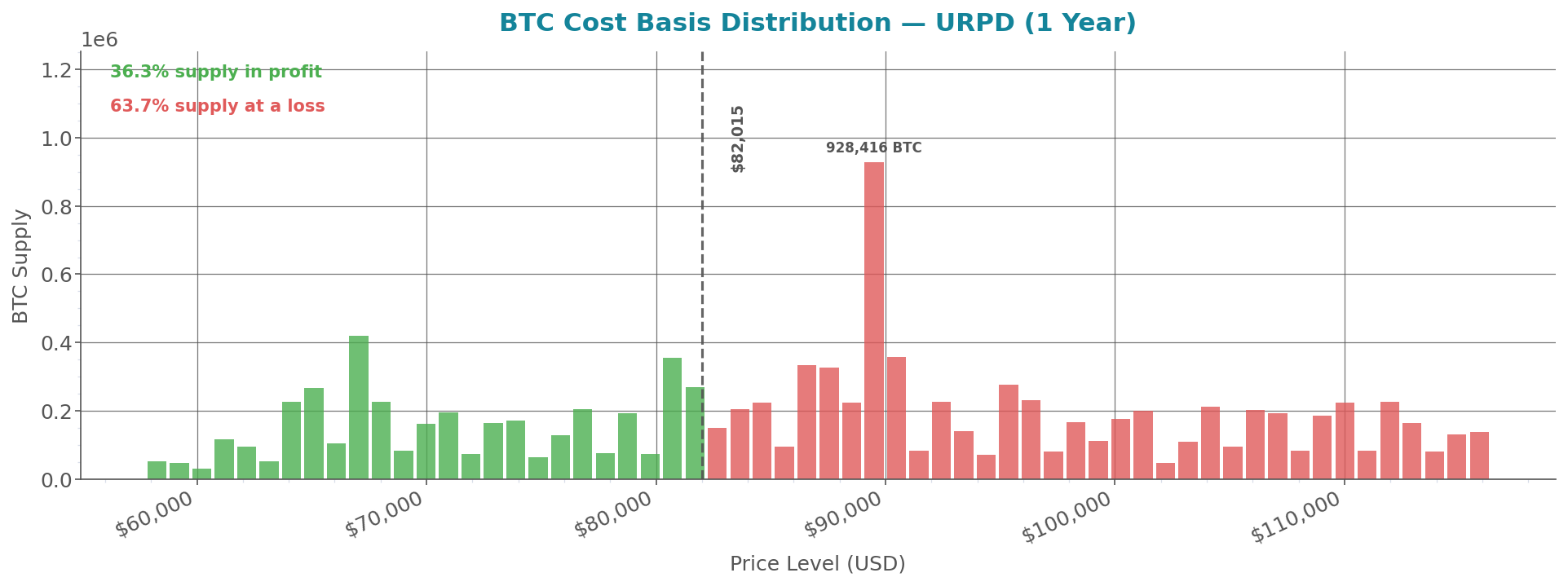
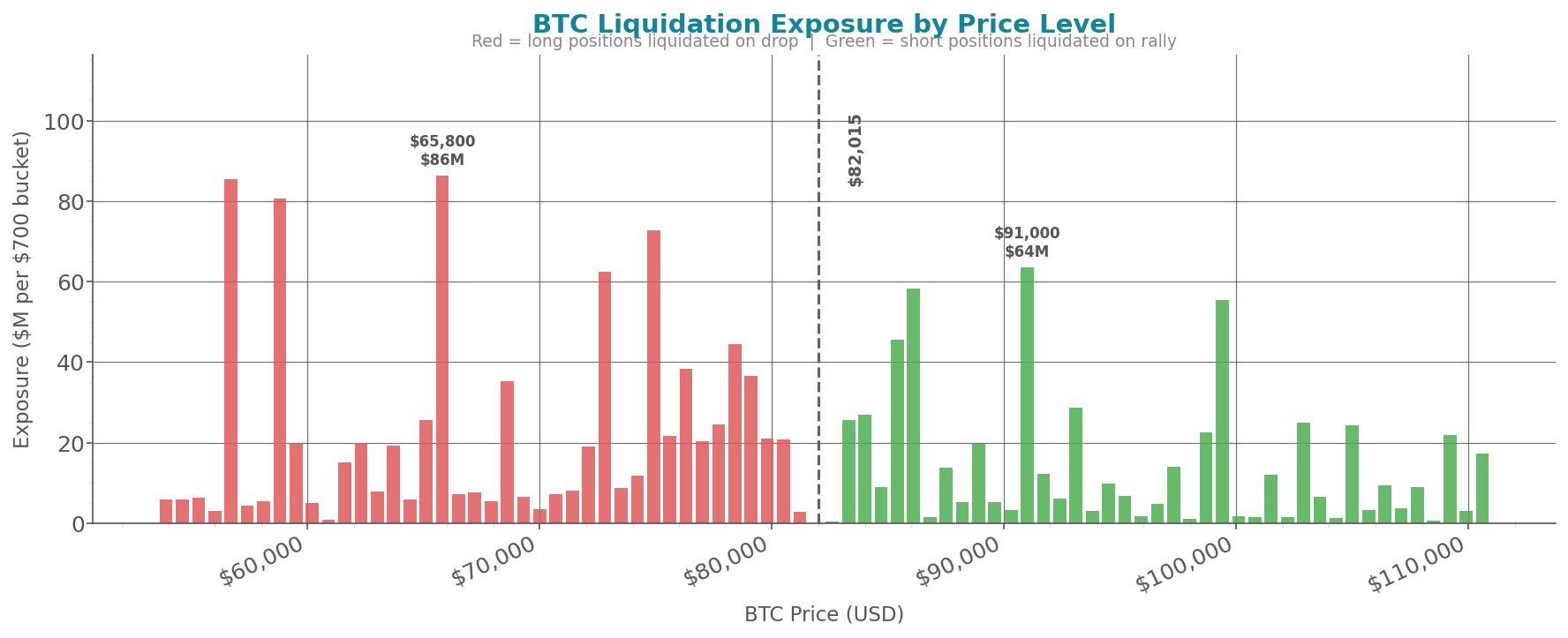
BTC's realized derivatives damage was concentrated in perpetual futures longs: $333M of BTC perp longs were liquidated over the week, versus $117M of BTC perp shorts. BTC's week-total long/short liquidation ratio was 2.85 — more longs were liquidated than shorts this week. The flush peaked on Thursday Oct 15, when $120M of BTC perp longs were liquidated in a single day, and liquidations stayed long-heavy into the final day, with $27M of BTC perp longs and $15M of BTC perp shorts liquidated on Sunday Oct 18 at a 1.79 ratio. US spot BTC ETFs added to the pressure, with $229M of net outflows over Oct 12–16. BTC is over-extended on the long side into next week: within 10% of BTC spot, $316M of BTC longs sit below versus $212M of BTC shorts above, so the LONG side is more exposed and the larger BTC cascade risk sits below BTC spot.
2. Key Risks & Levels for Next Week
Downside Long-Cascade Risk: BTC has a major cost-basis shelf at $80,260, where 247,408 BTC last moved, and the nearest meaningful long liquidation levels sit just below it at $79,100 ($36.6M) and $78,400 ($44.6M), ahead of the largest downside pocket at $74,900 with $72.7M of BTC longs exposed. The risk is that BTC spot selling through $80,260 turns passive supply into forced perp deleveraging that runs from $79,100 down toward $74,900. The tell is BTC spot volume expanding while BTC perp long liquidations accelerate, rather than a quiet drift through the cost-basis shelf.
Upside Short-Squeeze Risk: BTC shorts are stacked in steps above spot, with $25.7M at $83,300, $27.0M at $84,000 and $45.5M at $85,400, leading into the largest nearby pocket at $86,100 with $58.4M of BTC shorts. That top level sits almost exactly on a cost-basis cluster at $86,178 holding 188,288 BTC, so BTC shorts are most exposed where prior BTC holders have supply to sell. The risk is playing out if BTC perp short liquidations accelerate through the $83,300–$85,400 steps while BTC spot volume absorbs the $86,178 supply cluster.
Upper Supply-Wall Risk: BTC faces a dense overhead cost-basis band at $89,137 with 344,148 BTC, $89,729 with 584,268 BTC and $90,321 with 272,555 BTC, with the next BTC short-liquidation pocket at $91,000 carrying $63.6M of shorts. This zone is the main test of whether a BTC rally is real demand or just short-covering. Watch BTC spot volume and ETF flows: rising spot volume with ETF flows turning positive confirms real demand, while heavy spot selling into the band and continued ETF outflows leave BTC vulnerable to stalling below the $91,000 pocket.
ETH
ANALYST INTERPRETATION — ETH
1. Positioning & Derivatives Read
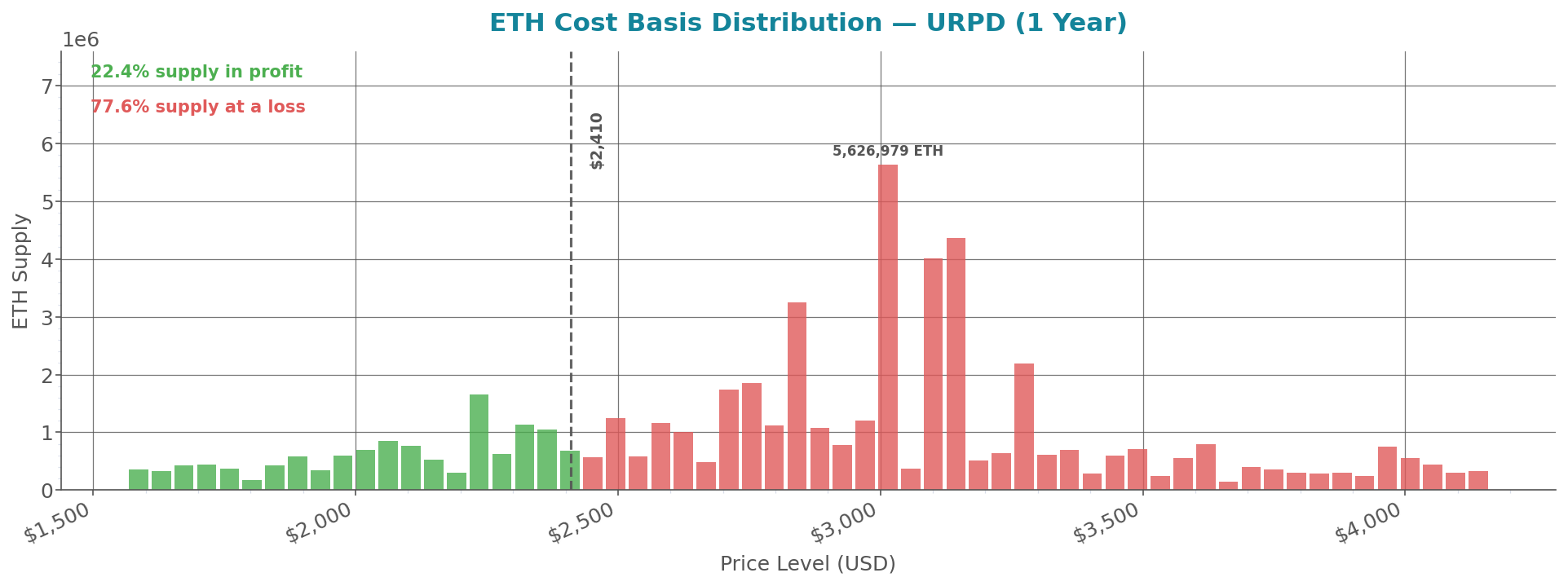
ETH fell 5.23% over the week, and the realized damage was concentrated in ETH perpetual longs. ETH perpetuals recorded $397M of long liquidations versus $127M of short liquidations, and the ETH week-total long/short liquidation ratio was 3.14, meaning more ETH longs were liquidated than ETH shorts this week. The flush peaked on Thursday Oct 15, when $172M of ETH perp longs were liquidated in a single day, and US spot ETH ETFs added to the pressure with $320M of net outflows over Oct 12–16.
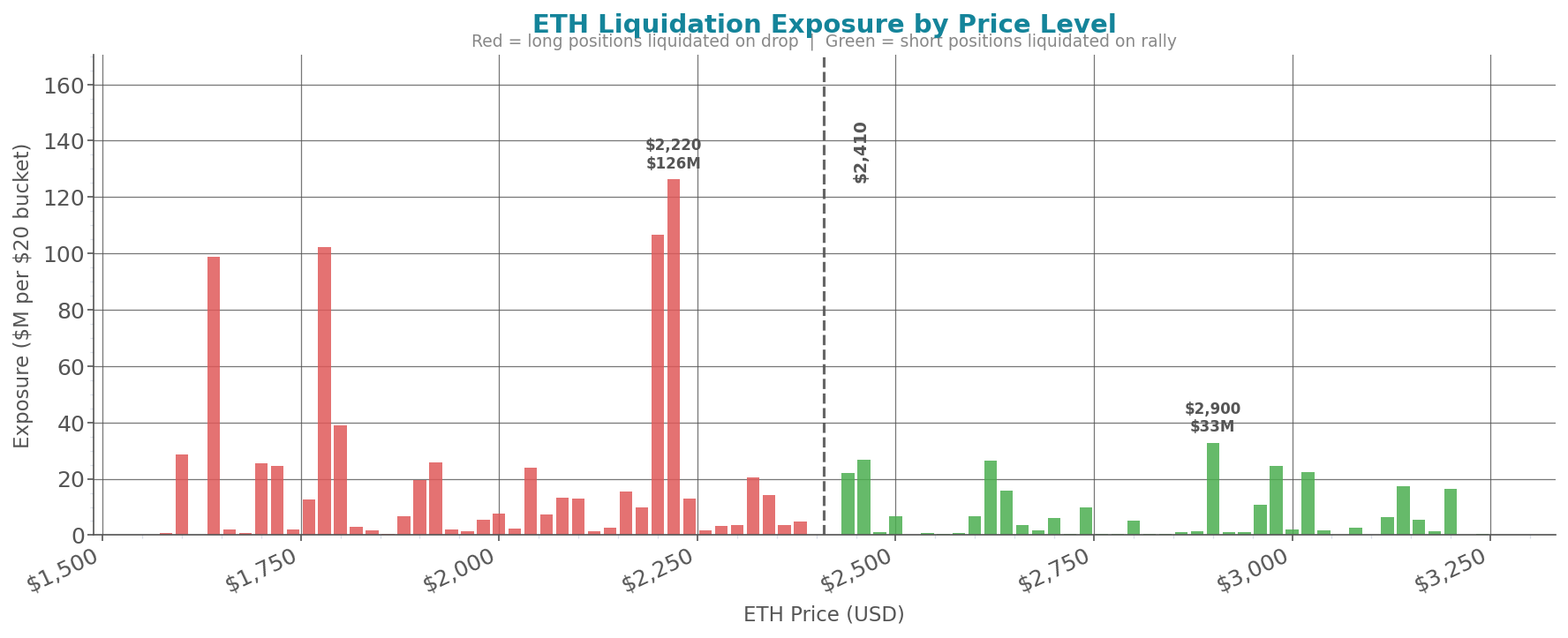
ETH longs were the crowded and punished side, while ETH shorts absorbed far less realized stress. ETH's final liquidation print was $26M of longs versus $22M of shorts on Sunday Oct 18, so the one-sidedness had narrowed by the end of the week without erasing the week's long-led washout. ETH longs remain over-extended going into next week: within 10% of ETH spot, $308M of long exposure sits below versus $107M of short exposure above, so the LONG side is the more exposed one.
2. Key Risks & Levels for Next Week
Long Liquidation Cascade: ETH spot at $2,410 sits just above large cost-basis shelves at $2,378 with 593,382 ETH, $2,325 with 1,135,857 ETH and $2,247 with 1,449,220 ETH. Those holders are in profit today; a break through those shelves pushes them underwater and adds spot supply right above the nearest meaningful long liquidation levels at $2,220 ($126.4M of longs) and $2,200 ($106.7M). Watch ETH spot volume rising into the selling and ETH perp long liquidations accelerating before price reaches $2,220, with continued ETF outflows as confirmation.
Overhead Supply Rejection: Nearer supply sits right above spot, with 560,000–660,000 ETH at each cost-basis level between $2,456 and $2,561, and short liquidations stepping up at $2,440 ($22.0M) and $2,460 ($26.7M). The larger wall is at $2,824 with 2,071,845 ETH, followed by $3,033 with 5,091,545 ETH, where holders return toward breakeven on a rally. ETH needs real spot demand rather than perp-led buying to absorb that inventory. Watch ETH spot volume and ETF flow direction: fading spot participation and continued ETF outflows into the rally mark it as supply absorption rather than a clean upside squeeze.
Short Squeeze Tail: The large ETH short liquidation bands sit much higher, with $53.8M of shorts at $3,920, $46.7M at $4,080 and the largest band at $4,120 with $260.2M. ETH has to clear the heavy cost-basis shelves at $3,112 with 2,945,459 ETH and $3,138 with 3,074,684 ETH before that zone becomes the dominant risk. Watch for ETH perp short liquidations accelerating alongside expanding spot volume and ETF flows turning positive; that combination would show shorts losing control before price reaches the heatmap bands.
On-Chain Signals — Bitcoin
| Signal | Week-End | Week Chg | Reading |
|---|---|---|---|
| MVRV Ratio | 1.552 | +0.2% | Moderate gains phase |
| NUPL | 0.360 | +0.2% | Optimism |
| Exch. Net Flow (week total) | +4,145.8 BTC | +2,461.5 BTC | Net inflows — distribution |
| Exchange Balance (USD) | $275.34B | +0.4% | |
| Perp Funding Rate | +0.00594% | +0.00292pts | Near-neutral |
| Perp Open Interest | $34.66B | +1.1% | |
| 1M Implied Vol | 36.8% | +1.5pts | Low vol environment |
| 25Δ Put/Call Skew | 8.2% | +0.9pts | Slight downside bias (puts bid) |
| Realized Vol (1W) | 23.5% | -1.1pts | Moderate |
| DVOL Index | 38.82 | +2.9% | |
| Accumulation Balance | 2,013,242 BTC | +0.0% | |
| Supply Held ≥100k BTC | 696,799 BTC | +1.0% | |
| Net Realized P/L (week total) | +$729.6M | -$1,875.8M | Coins moved at a profit |
Amber rows deviate >1.5σ from prior 4-week baseline • data as of 2026-10-18
Bitcoin's on-chain metrics remain consistent with a market that is profitable but not yet at historically overheated levels: MVRV stands at 1.552 and NUPL at 0.360, both up just 0.2% week over week. Exchange net inflows totalled 4,145.8 BTC for the week, but the total came from a single day: 6,981.8 BTC flowed in on Thursday Oct 15, the day of the week's long liquidation flush, while the other six days netted 2,836 BTC of outflows. That points to a one-day burst of exchange-side supply rather than steady distribution, and inflows alone do not establish that investors are selling.
Derivatives positioning increased modestly, with perpetual open interest rising 1.1% to $34.66B and funding remaining near neutral at +0.00594%. Options show rising demand for downside protection: one-month implied volatility rose 1.5 points to 36.8%, still a low-volatility reading, while the 25-delta skew rose to 8.2%, meaning puts are priced above calls, after climbing from 5.0% on Oct 8. Spot CVD ended the week 2.4 standard deviations below its four-week baseline, with the steepest drop on Oct 14–15, pointing to net aggressive spot selling. Taken together, these signals describe a market with moderate on-chain profitability but some near-term hedging and selling pressure.
Weekly Market Wrap
Cross-asset markets repriced risk. From the Oct. 9 close to Oct. 16, the S&P 500 dropped 1.95% and the Nasdaq dropped 4.48%, while the Dow Jones rose 0.67% and the VIX rose 5.15 points. The divergence extended across asset classes: WTI crude gained 10.41% amid Middle East supply concerns, the dollar index fell 0.36%, gold declined 0.83%, and Treasury yields fell across the curve, with the 10-year down 15bp, the 5-year down 12bp, and the 30-year down 16bp. Together, these moves reflected competing inflation, geopolitical, and growth concerns rather than a uniform retreat from risk.
Technology led US equity losses, while Europe outperformed. Nvidia dropped 6.61%, Tesla dropped 7.31%, Amazon dropped 4.74%, and Intel dropped 14.18%, weighing on the Nasdaq. Apple rose 2.03% and JPMorgan rose 2.02%, helping the Dow outperform. The macro backdrop remained challenging, with September CPI up 3.7% year over year, wholesale inflation at 6.3%, and the fiscal 2026 deficit approaching $2 trillion. Despite falling Treasury yields and no clear signal of more aggressive tightening from Fed Chair Kevin Warsh, concerns about AI investment returns and technology-sector positioning persisted. European equities gained ground, with the FTSE 100 up 3.13%, the DAX 2.13%, the CAC 40 1.97%, and the Swiss Market Index 4.38%. Asian markets were mixed: the TOPIX ETF dropped 0.95% and the Hang Seng dropped 0.10%. China’s third-quarter GDP growth accelerated to 4.5%, UK GDP rose 0.1% in August, and India’s September inflation reached 5.54%.
Crypto declined amid security and regulatory concerns. Over Oct. 12–19, Bitcoin dropped 1.46%, from $83,922.83 to $82,701.62; Ethereum dropped 5.23%, from $2,563.20 to $2,429.21; and Solana dropped 6.00%, from $112.43 to $105.68. Institutional developments remained constructive: Standard Chartered expanded its digital-asset services in the UAE, Payward received full Dubai approval, Deutsche Bank advanced plans for German crypto custody, and Mastercard introduced a stablecoin-integrated payments platform. However, security incidents and regulatory scrutiny weighed on the backdrop. Concerns over tampered Ledger hardware wallets spread across resellers, Hacken attributed 77% of Q3 hack losses to compromised suppliers, Cysic suspended its bridge after an unauthorized mint of 10 million CYS tokens, and Qubic halted its network after approximately 1,400 wallets were drained. South Korea moved against 27 unregistered crypto websites, Australia proposed tighter leverage and platform rules, and Russia set a July 1, 2027 deadline for a ban on direct peer-to-peer crypto trades.
The week ahead centers on monetary policy, energy, and regulation. The October Fed decision will be a key catalyst, with markets also watching geopolitical developments and the potential inflationary effects of higher oil prices. Attention will remain on the implications of the US sanctions waiver for Russian oil and diplomatic proposals concerning Ukraine. In crypto, South Korean officials’ planned meeting with major exchanges on a possible two-year delay to crypto taxation is a key near-term policy development.