
WEEKLY MARKET DIGEST • November 09 – November 16, 2026
TLDR
- Bitcoin fell 12% and Ethereum 13% over the completed November 9–15 UTC week, extending losses amid tighter financial conditions and hawkish Fed repricing.
- Gold declined 4.6% from the November 6 to November 13 close as higher Treasury yields and a stronger dollar weighed on bullion.
- The 10-year yield rose 29 bp to 5.15%. Hotter-than-expected October CPI and hawkish comments from Fed Governor Christopher Waller accelerated December rate-hike repricing. Waller said a 50 bp hike should be considered if inflation remained elevated.
- The S&P 500 gained 2.5% on the week, while the VIX fell 6.3 points to 19.30, signalling a sharp decline in implied volatility despite rising yields.
- Coming week: Watch US retail sales and industrial production on November 17, followed by PCE inflation on November 25. These releases will help determine whether the Fed delivers the expected 25 bp December hike or whether a larger 50 bp move remains a possibility.
Weekly Market Performance
| Asset | Prior Week Close | Week Close | Weekly Change | 1M Change |
|---|---|---|---|---|
| Global Crypto Market Cap | $2.48T | $2.18T | -11.83% | — |
| S&P 500 | 7,376.86 | 7,561.67 | +2.51% | -1.28% |
| Dow Jones | 51,285.73 | 52,347.55 | +2.07% | +0.66% |
| Nasdaq | 24,579.42 | 25,136.27 | +2.27% | -3.84% |
| VIX | 25.64 | 19.30 | -6.34 pts | -0.69 pts |
| Bitcoin (BTC) | $74,205 | $64,553 | -13.01% | -20.78% |
| Ethereum (ETH) | $2,116 | $1,809 | -14.49% | -25.50% |
Macro Highlights
Treasuries took the week’s main macro repricing: from the Nov. 6 close to Nov. 13, the 10-year yield rose 29 bp to 5.15%. Traders cited October CPI and Waller’s signal that he is leaning toward a December rate increase, with a half-point move dependent on inflation data. The dollar index gained 1.09% to 103.41 on the week, while gold fell 4.6%. The S&P 500 gained 2.5% to 7,561.67 on the week and the VIX fell 6.34 pts to 19.30.
Fed hikes repriced after inflation
The Fed rate debate shifted toward a December increase after October inflation data and hawkish Fed comments put a half-point move on the table. On Tuesday, Waller said he was leaning toward a December increase, with a 50 bp move dependent on inflation remaining elevated. October CPI rose 0.4% m/m, with core CPI up 0.3%. On Wednesday, Goolsbee called the report “borderline disturbing.” Friday’s PPI added to the pressure, rising 0.3% m/m and 6.5% y/y, its highest annual rate since November 2022.
AI trade confidence shaken
Nvidia’s scandal widened into a US-China technology-policy dispute. The investigation into alleged Chinese espionage linked to Megaspeed brought scrutiny of advanced chip sales and export controls, while Beijing warned Washington against using the allegations to justify new restrictions. US lawmakers pressed Commerce Secretary Lutnick over the chip sales, and scrutiny of Jensen Huang’s reported relationship with a former Megaspeed executive added pressure on Nvidia. On Monday, Megaspeed confirmed an internal investigation led by outside lawyers, while Reuters reported that Indonesian police had previously raided its local subsidiary at the request of US authorities. The allegations remain unproven, but the affair adds a new policy risk to the AI trade beyond semiconductor demand.
(CNBC) (Financial Times) (Bloomberg) (The New York Times)
Oil balances Iran risk and surplus
WTI crude fell 2.5% on the week to $88.56 as surplus calls outweighed bursts of Iran-related risk. Early in the week, crude fell after Trump agreed to maintain the U.S.-Iran status quo and pulled back from a threat to strike Iran. Prices then rose when Iranian leaders hardened their stance and Trump said no Iran deal was needed, but Friday’s trading brought the International Energy Agency’s surplus forecast back against the geopolitical risk. On Monday, dollar strength and global surplus prospects weighed on crude, and Goldman Sachs warned of a “sizable” oil-market surplus in 2027.
(Bloomberg) (Nasdaq) (CNBC) (Financial Times)
China demand disappoints
China’s October activity weakened across investment, consumption and industrial output, while stimulus had yet to lift domestic momentum. Data released Monday showed investment worsened unexpectedly and consumption and industrial output undershot estimates. Industrial production grew 4.8% y/y, down from 5.5% in September, while retail sales growth slowed to 0.4%. Fixed-asset investment fell 8.1% in the first ten months. Helen Qiao of BofA Global Research said domestic demand faces further deterioration. For commodities, China’s demand data remain the test, while weak consumption and investment reinforce concerns about domestic momentum.
(Bloomberg) (Financial Times) (CNBC)
Week ahead
- Tue Nov 17 - Advance Monthly Sales for Retail and Food Services: a stronger sales print would support the demand side of Fed-hike pricing after October CPI and PPI.
- Tue Nov 17 - G.17 Industrial Production and Capacity Utilization: a weaker production print would add to cyclical-demand worries already showing in China data and oil-surplus calls.
- Wed Nov 25 - Personal Income and Outlays: a faster PCE price index would keep the half-point December Fed debate alive; a slower one would shift the debate back toward a smaller hike.
- Wed Nov 18 - FOMC minutes from the October 27–28 meeting: traders will look for further clues about the Committee’s inflation concerns and December rate outlook.
Crypto Highlights
After Binance suffered a $6.3 billion hack, Elliptic said North Korean hackers created six NEAR memecoins to launder stolen funds via liquidity pools, and analysts said Binance pledged to cover user losses. The Justice Department has now moved to seize $1.2 billion linked to the Binance hack, frozen more than $2.7 billion in proceeds, and separately disrupted the FaceStealer scam that stole more than $400 million over 18 months.
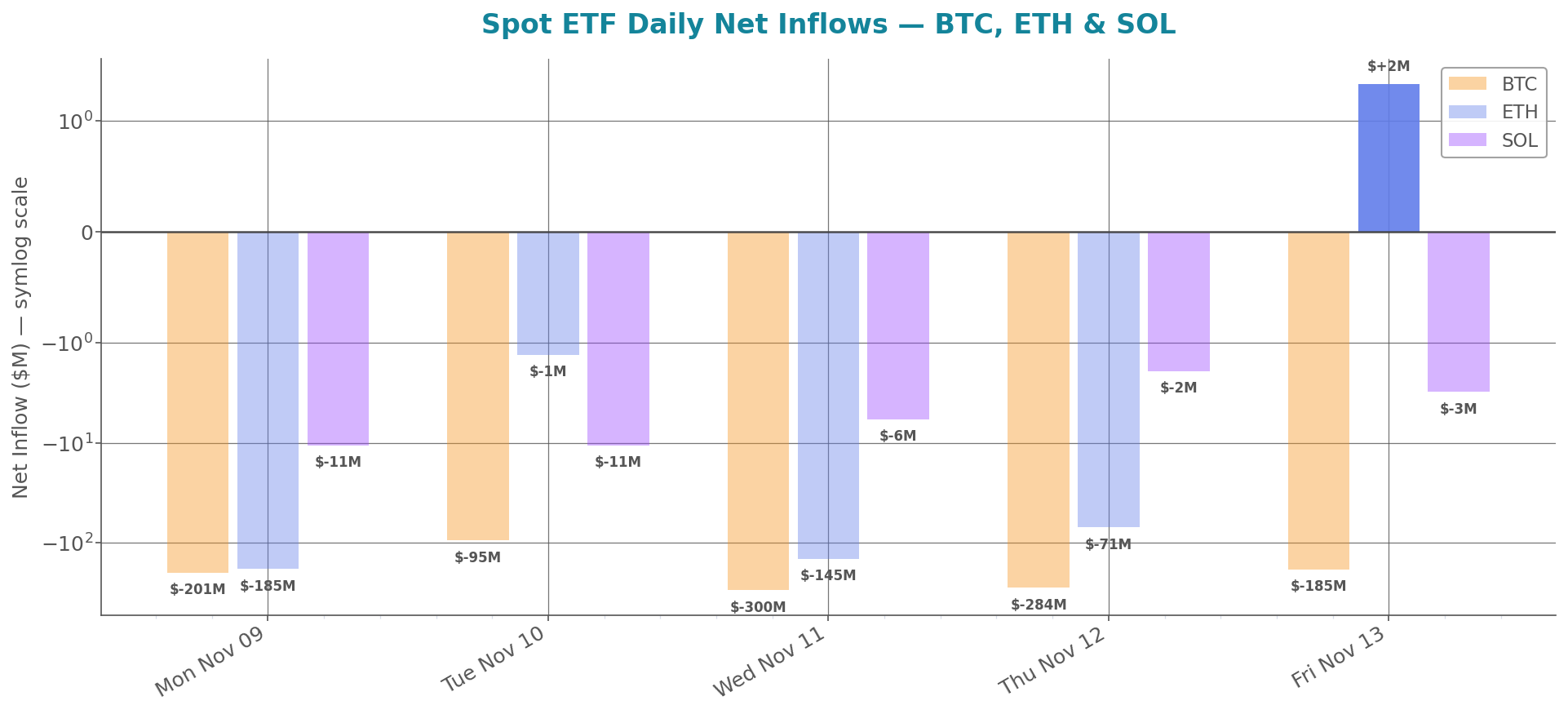
US spot Bitcoin ETFs shed $2.35 billion over two weeks, including $185.4 million on Friday, with BlackRock’s IBIT accounting for $143.5 million and extending an 11-session outflow streak. Bitcoin has since fallen to a four-month low near $62,000, while total crypto market capitalization dropped 4% over 24 hours to $2.26 trillion.
Coinbase’s US national trust bank charter took effect on Nov. 9, allowing it to expand institutional crypto custody and explore digital asset payment products, and US regulators gave final clearance to its trust company on Nov. 13. Senate lawmakers are seeking compliance and conflict-of-interest records from crypto firms, while Sen. Richard Blumenthal asked Binance, Tether and Trump crypto firms to start sending records by Nov. 30 ahead of a Jan. 4 final deadline.
The New York Stock Exchange selected Avalanche to support settlement for a planned tokenized stock trading platform, Kraken’s parent added more than 200 tokenized UK and EU stocks to xStocks, and OKXICE said it will debut tokenized stocks on Nov. 23 under a new SEC exemption. DTCC has now announced plans to expand to Solana in 2027 with tokenized stocks, while analysts cited potential access limits from wallet rules.
Attackers redirected customers’ Bitcoin mining power through Luxor’s Commander platform over the weekend, prompting Luxor’s CEO to warn crypto businesses about an AI “dark forest.” Luxor said the incident involved its Commander platform and issued the warning after the hijack, with the article not specifying stolen amounts.
US Spot ETF Flows
| Fund | Weekly Net Flow | Cumulative Inflow | AUM |
|---|---|---|---|
| BTC Spot ETF | $-1,065.4M | +$54,633.1M | $86.20B |
| ETH Spot ETF | $-398.9M | +$11,523.6M | $10.85B |
| SOL Spot ETF | $-32.1M | +$1,410.4M | $1.14B |
Spot ETF Daily Flows — BTC, ETH & SOL
Cost Basis Distribution & Liquidation Exposure
BTC
ANALYST INTERPRETATION — BTC
1. Positioning & Derivatives Read
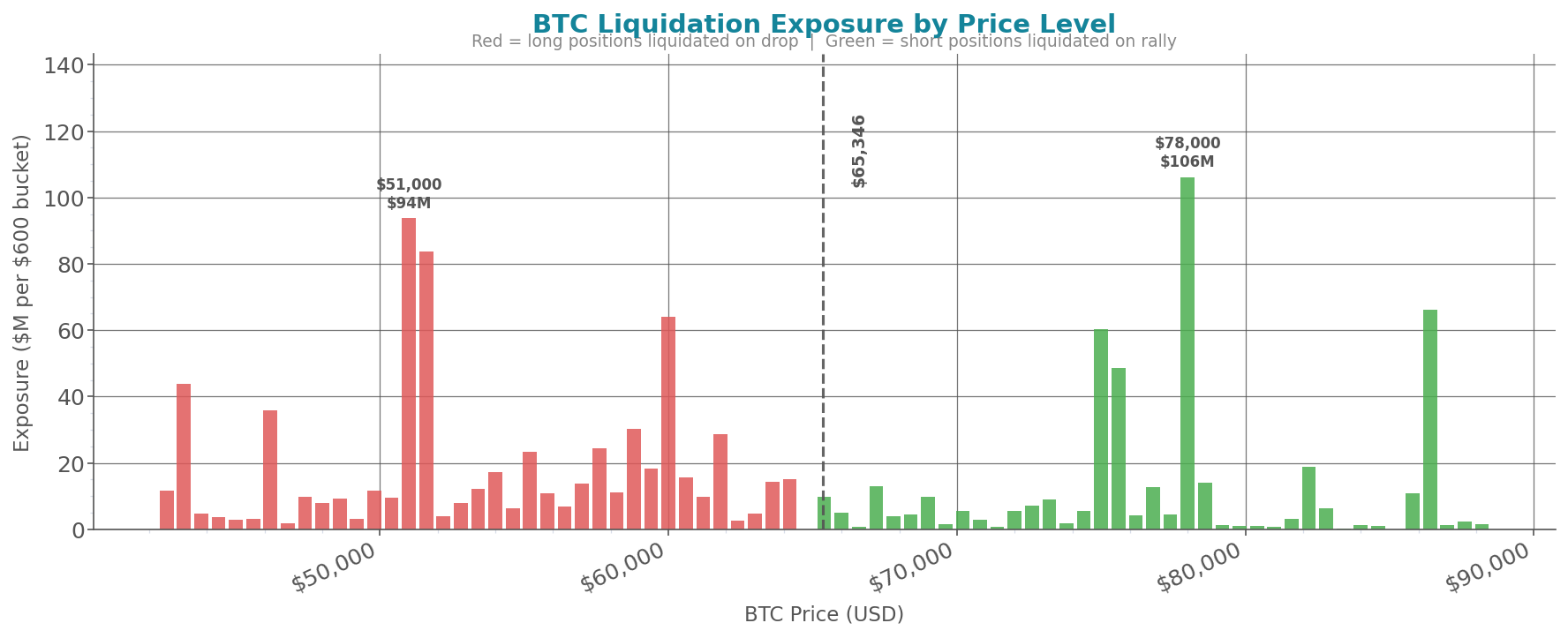
Glassnode recorded $1,032M of BTC perp longs liquidated and $183M of BTC perp shorts liquidated this week, and these are perpetual futures liquidations for BTC only. The BTC long/short liquidation ratio was 5.65. From the Nov 09 close to Nov 16, BTC fell 13%, so the realised pain was concentrated in leveraged BTC longs. BTC ETF flows reinforced that pressure, with $1,065M of net outflows from Mon Nov 09 to Fri Nov 13 against $86.2B of AUM and $54.6B of cumulative flows. BTC perp deleveraging was still not fully one-sided by the final day, with Sunday BTC perp liquidations at $94M of longs and $63M of shorts, but the week-total damage clearly sat with BTC longs. BTC remains over-extended on the long side going into next week: the ON-CHAIN LEVELS data names the LONG side as more exposed, with $196M of BTC longs within 10% below spot versus $58M of BTC shorts above spot, so the larger cascade risk is below BTC spot.
2. Key Risks & Levels for Next Week
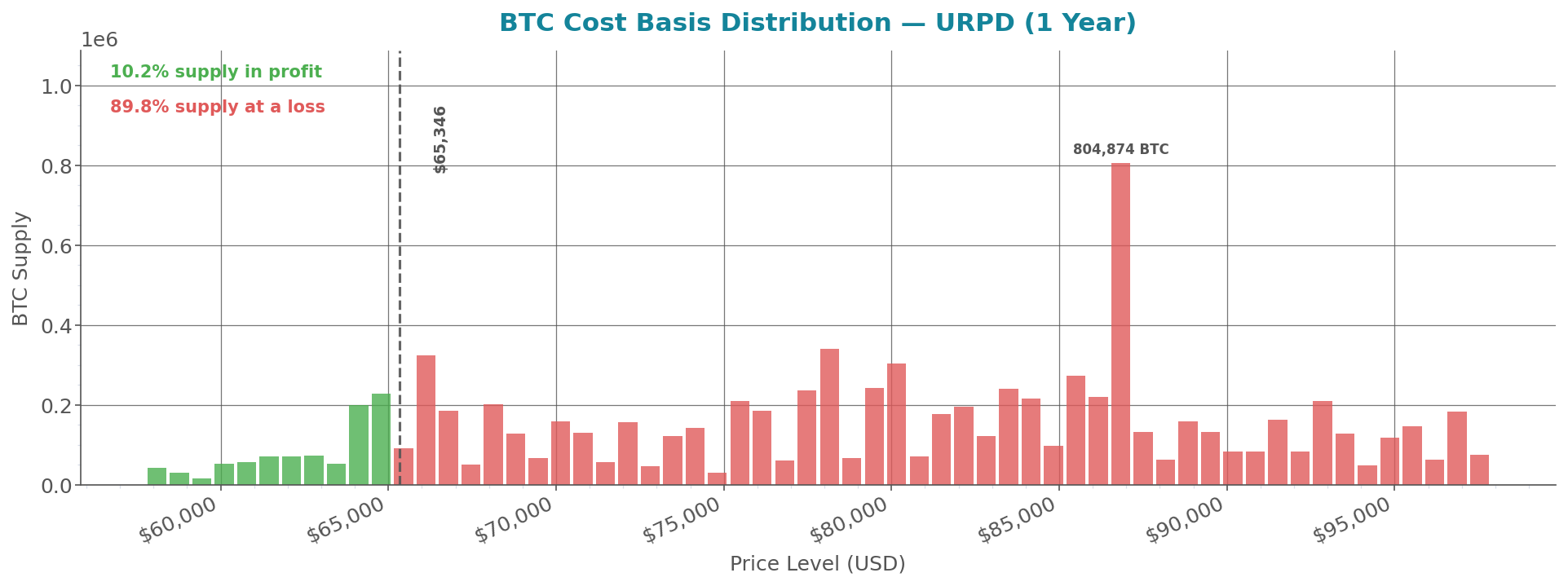
Long Liquidation Cascade: BTC spot sits above nearby cost-basis support at $65,060 with 92,090 BTC, $64,656 with 136,430 BTC, and $63,846 with 145,256 BTC, so failure of absorption through that band leaves BTC longs exposed into $61,800 and $60,000. BTC liquidation exposure below spot is $28.6M of longs at $61,800 and $63.9M of longs at $60,000, making that the first major downside cascade zone. The signal that BTC downside risk is playing out is rising BTC spot volume into the move, continued negative BTC ETF flows, and an accelerating BTC perp long-liquidation rate.
Near-Spot Short Squeeze: BTC spot has the nearest upside short-liquidation levels at $65,400 with $9.7M of shorts, $67,200 with $13.1M of shorts, and $69,000 with $9.7M of shorts. BTC also has a cost-basis cluster at $65,870 with 181,188 BTC, so a push through the first short band runs directly into supply that tests whether BTC demand is real or only forced covering. The signal that BTC squeeze risk is playing out is BTC spot volume expanding on the way higher, BTC ETF flows turning positive, and BTC perp short-liquidation rates accelerating before the larger upside bands are reached.
Higher Resistance and Forced Covering: BTC has a larger upside confluence at $78,000 and $78,018, where $106.1M of BTC shorts sits alongside 227,659 BTC of cost basis. BTC also has $60.4M of shorts at $75,000, so forced covering can begin before the larger $78,000 liquidation pocket. The signal that BTC is moving from relief into a squeeze is sustained BTC spot volume, improving BTC ETF flow direction, and BTC options skew shifting toward upside demand.
ETH
ANALYST INTERPRETATION — ETH
1. Positioning & Derivatives Read
Glassnode recorded $614M of ETH perpetual future longs liquidated and $139M of ETH perp shorts liquidated this week; the week-total long/short liquidation ratio was 4.43, meaning more ETH longs were liquidated than shorts. ETH fell 14.49% from the Nov 09 close to the Nov 16 close, so the liquidation data shows the week’s loss forced leverage out primarily from ETH longs. ETH ETFs had a $399M net outflow from Mon Nov 09 to Fri Nov 13, reducing sponsorship against $10.9B of AUM and a $11.5B cumulative flow base. ETH is downside-overextended rather than under-extended after a long-led perp washout and ETF outflows, and ETH shorts are the more exposed side going into next week because exposure within 10% of ETH spot is $46M of shorts above versus $18M of longs below.
2. Key Risks & Levels for Next Week
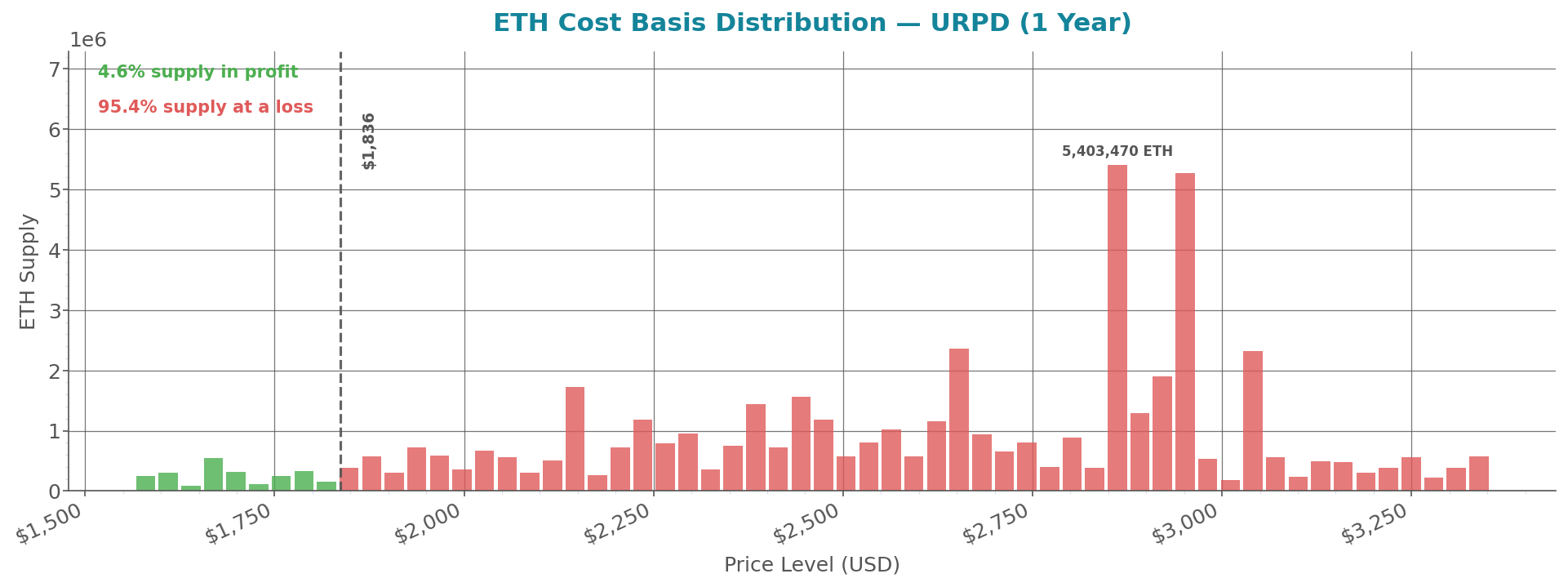
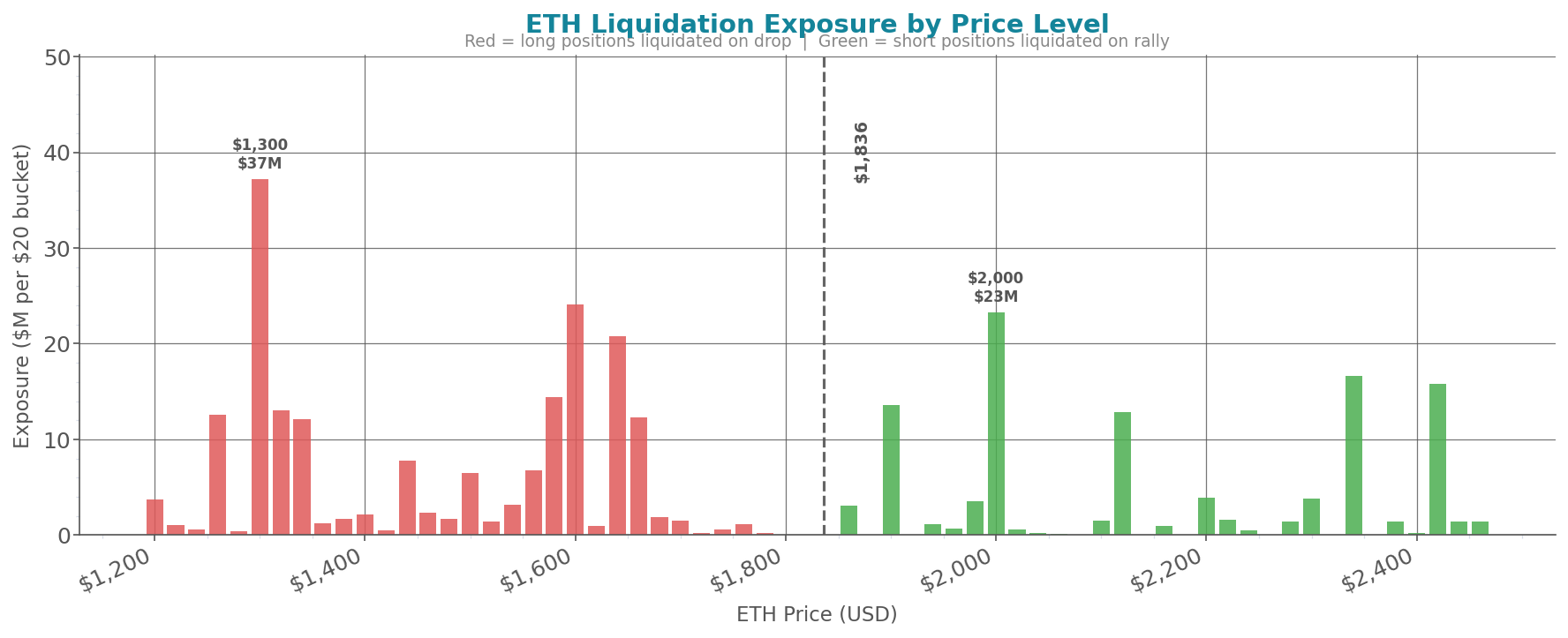
Short-Squeeze Risk: ETH spot at $1,836 sits below the nearest meaningful short-liquidation levels at $1,900 with $13.6M of shorts and $2,000 with $23.3M of shorts, and ETH has $46M of short exposure within 10% above spot. Those levels matter because a rally into them forces ETH shorts to buy back exposure before the heavier $2,920 band, where $54.8M of shorts sits alongside 1,902,875 ETH of cost-basis supply. The signal is ETH spot volume rising into the move with ETF flows turning from the prior $399M weekly net outflow to inflow and perp short liquidations accelerating.
Near-Term Long-Cascade Risk: ETH spot at $1,836 has the nearest meaningful long-liquidation levels below at $1,680 with $1.9M of longs and $1,660 with $12.3M of longs. That zone matters because ETH cost-basis supply is nearby at $1,673 with 202,261 ETH and $1,655 with 341,649 ETH, so selling through it puts a dense owner cohort under pressure at the same time leverage starts liquidating. The signal is ETH perp long-liquidation rates accelerating before spot reaches the zone, with ETH ETF outflows extending rather than stabilising.
Deeper Flush Risk: ETH spot has a larger long-liquidation pocket at $1,600 with $24.1M of longs, below the $1,619 cost-basis cluster that contains 181,719 ETH. A move into that area matters because ETH long exposure below spot increases after the shallow $1,680 and $1,660 bands, turning a spot selloff into a leverage event. The signal is ETH spot volume rising on down candles while perp long liquidations accelerate and ETF outflows persist.
On-Chain Signals — Bitcoin
| Signal | Week-End | Week Chg | Reading |
|---|---|---|---|
| MVRV Ratio | 1.237 | -13.0% | Fair value zone |
| NUPL | 0.196 | -34.8% | Hope / Fear |
| Exch. Net Flow (week total) | +10,764.1 BTC | +9,389.2 BTC | Net inflows — distribution |
| Exchange Balance (USD) | $225.52B | -12.9% | |
| Perp Funding Rate | +0.00205% | -0.00653pts | Near-neutral |
| Perp Open Interest | $29.16B | -17.0% | |
| 1M Implied Vol | 41.0% | +3.4pts | Moderate vol |
| 25Δ Put/Call Skew | 18.0% | +9.8pts | Puts expensive — fear |
| Realized Vol (1W) | 41.7% | -8.6pts | Elevated |
| DVOL Index | 43.95 | +10.2% | |
| Accumulation Balance | 1,961,974 BTC | +0.8% | |
| Supply Held ≥100k BTC | 698,234 BTC | -2.3% | |
| Net Realized P/L (week total) | -$5,209.8M | -$3,755.3M | Coins moved at a loss |
Amber rows deviate >1.5σ from prior 4-week baseline • data as of 2026-11-15
Notable — Perp Open Interest: 9.5σ below 4-week baseline
Notable — NUPL: 6.5σ below 4-week baseline
Cycle metrics reset sharply: MVRV fell 13.0% to 1.237 and NUPL dropped 34.8% to 0.196, leaving BTC holders with thin unrealized profits as weekly realized P/L sank to -$5.21B. Derivatives show deleveraging rather than crowded longs: perp OI dropped 17.0% to $29.16B, 9.5σ below its 4-week baseline, funding faded to +0.00205%, and 1M IV/skew rose to 41.0%/+18.0% as puts were bid. Exchange net inflow of +10,764 BTC was almost entirely Thu's +10,136 BTC, a routine daily size; the real outliers were OI and 20d BB width, 7.1σ high, signaling volatility expansion.
Weekly Market Wrap
October inflation broadened enough to keep another Federal Reserve rate increase in play, and that was the week's central macro development. From the Nov 6 close to Nov 13, Treasury yields rose sharply, with 5y +33bp, 10y +30bp and 30y +22bp. Governor Waller said before the CPI report that a half-point move in December should be considered if core inflation came in near 0.3%, and it did. Chicago Fed's Goolsbee called the inflation report "borderline disturbing" and later said the central bank "has definitely got work to do." The dollar index gained 1.09% on the week, EUR/USD fell 1.59%, gold fell 4.63%, and WTI crude fell 2.50%.
US equities still ended higher on the week, with the S&P 500 up 2.51%, the Dow Jones up 2.07% and the Nasdaq up 2.27%, while VIX -6.34 pts. Investors welcomed easing Middle East tensions and lower oil prices early in the week, before hotter inflation readings, hawkish Fed comments and Nvidia's leadership crisis weighed on sentiment. Sector moves showed the equity advance was not confined to one corner: energy gained 5.42%, industrials gained 3.76%, communication services gained 3.72% and technology gained 3.36%, even as Nvidia fell 12.75%. Outside the US, the Eurozone ETF gained 2.84%, the DAX gained 3.60% and the FTSE 100 gained 2.14%. China stood apart: the China ETF fell 4.47% and the Hang Seng fell 3.45%. October data published on Nov 16 then showed weaker consumption, industrial output and investment. Japan's TOPIX ETF gained 6.92%, recovering a 6.50% drop on Nov 6. Data on Nov 16 showed Japan's economy contracted in the third quarter on elevated energy costs, weak consumer spending and prolonged rain.
Crypto had a much harder week. From Nov 9 to Nov 16, Bitcoin fell 13.01% to $64,552.98, Ethereum fell 14.49% to $1,809.49 and Solana fell 17.56% to $70.96. US spot ETFs recorded net outflows of $1.065 billion from BTC funds, $399 million from ETH funds and $32 million from SOL funds from Monday to Friday. The week also brought a dense run of institutional and regulatory developments: Coinbase's US national trust bank charter took effect, Deutsche Bank launched crypto custody for companies and institutions, and the White House nominated candidates to fill SEC and CFTC vacancies. Senator Blumenthal asked Binance, Tether and Trump-linked crypto firms to begin producing records by Nov 30, with a final deadline of Jan 4. Security remained prominent, with the Department of Justice moving to seize $1.2 billion from the Binance hack, while South Korea's regulator moved to permit crypto withdrawal freezes during hacking threats and Thailand's SEC proposed a $148,000 daily cap on stablecoin deposits and withdrawals.
This week's first equity catalyst is Nvidia earnings on Nov 17, with traders already bracing for the report after Jensen Huang's resignation and the renewed focus on the AI trade. Anthropic's IPO, pricing on Nov 18, is another market test after the same AI concerns dominated late-week positioning. In crypto market structure, OKXICE is scheduled to debut tokenized stocks on Nov 23 under a new SEC exemption, a launch that will be watched alongside the broader push into tokenized equities by exchanges, custodians and settlement platforms.