
WEEKLY MARKET DIGEST • November 02 – November 09, 2026
TLDR
- WTI crude fell 12.76% from the Oct 30 close to Nov 6 as traders bet U.S.-Iran diplomacy reduced war-risk pricing.
- Ethereum fell 7.32% from the Nov 2 close to Nov 9, with levered longs absorbing liquidation stress.
- The Nasdaq fell 3.37% on the week as Dan Niles cited data-center constraints and higher funding costs.
- The 10y fell 7bp on the week after Democrats won both chambers, limiting the Trump administration's tax and spending plans.
- CPI lands Nov 10; a higher print would strengthen the Fed-hike case and support the dollar.
Weekly Market Performance
| Asset | Prior Week Close | Week Close | Weekly Change | 1M Change |
|---|---|---|---|---|
| Global Crypto Market Cap | $2.62T | $2.48T | -5.30% | — |
| S&P 500 | 7,580.07 | 7,376.86 | -2.68% | -5.56% |
| Dow Jones | 51,770.31 | 51,285.73 | -0.94% | -0.71% |
| Nasdaq | 25,437.00 | 24,579.42 | -3.37% | -10.18% |
| VIX | 19.42 | 25.64 | +6.22 pts | +10.80 pts |
| Bitcoin (BTC) | $78,063 | $74,205 | -4.94% | -10.29% |
| Ethereum (ETH) | $2,283 | $2,116 | -7.32% | -15.16% |
Macro Highlights
CPI 3.72% y/y Sep · Core CPI 2.57% y/y Sep · Core PCE 3.12% y/y Sep · Unemployment 4.10% Oct · Payrolls +165k m/m Oct · Real GDP 3.40% q/q Jul
The AI trade broke from unease into repricing. From the Oct. 30 close to Nov. 6, the Nasdaq fell 3.37% on the week to 24,579.42 as Dan Niles cited U.S. data-center constraints and higher funding costs forcing investors to reassess valuations. Gold rose 4.51% on the week to $4,074.90, and the VIX rose 6.22 pts to 25.64.
Oil risk premium fades
Oil sold off as Iran diplomacy and the U.S. midterm result cut the geopolitical risk premium. WTI crude fell 12.76% on the week to $90.83. Early in the week, investors weighed Iran-Qatar talks and comments from Iran President Masoud Pezeshkian and President Donald Trump pointing to progress in negotiations. After Democrats won both chambers of Congress, traders bet the result would speed efforts to end the U.S.-Iran war, before prices rose Friday as investors weighed renewed military-escalation risk against a diplomatic breakthrough.
AI funding stress spreads
The AI infrastructure buildout is facing growing political resistance, data-center capacity constraints and tighter financing conditions following the November 2026 US midterm elections. In Texas, Governor Greg Abbott had already imposed restrictions on data-center approvals ahead of the election, while Democratic gains added political momentum to calls for tougher regulation, including a national moratorium proposed by Senator Bernie Sanders. Niles Investment Management founder Dan Niles said infrastructure constraints, falling AI token prices and higher funding costs were forcing investors to reassess AI valuations. Separately, ING was reportedly seeking bids for approximately $500 million across 12 data-center loans, including exposure to a New Mexico site associated with the Stargate project. The next market test is whether banks and private-credit lenders continue financing AI infrastructure at borrowing costs that support ambitious expansion plans and the equity valuations built around them.
Strong jobs keep Fed hawkish
Stronger US labor-market data increased expectations of another Federal Reserve rate hike in December. September job openings rose by 333,000 to 7.523 million, while ADP reported that private companies added 86,000 jobs in October. Nonfarm payrolls increased by 165,000 to 159.29 million, unemployment was little changed at 4.1%, and average hourly earnings rose $0.14 to $38.00, up 3.1% year over year. The dollar index closed at 102.30 on November 6, gaining approximately 0.3% over the week, with stronger employment data and expectations of tighter monetary policy supporting the currency. Markets subsequently priced in an 81% probability of a December 9 rate increase.
(Nasdaq) (Bloomberg) (Financial Times) (The New York Times)
Democratic sweep lowers fiscal premium
Treasuries initially rallied after Democrats won control of both chambers of Congress in the November midterm elections, as investors anticipated that divided government would constrain the Trump administration's tax-cut and spending agenda. The 10-year yield fell sharply following the result, although it subsequently reversed some of its decline. Investors also responded to falling oil prices and expectations of reduced inflationary pressure amid hopes of de-escalation in the Iran conflict. The Treasury's quarterly refunding plan, which maintained existing coupon auction sizes, provided some reassurance about near-term debt supply.
Week ahead
- Tue Nov 10: October Consumer Price Index (CPI), 8:30 a.m. ET. A stronger-than-expected inflation reading would reinforce expectations of tighter Fed policy and potentially support the dollar.
- Fri Nov 13: October Producer Price Index (PPI), 8:30 a.m. ET. Higher producer prices would add to inflation concerns and strengthen the case for a hawkish Fed.
- Tue Nov 17: October Advance Monthly Sales for Retail and Food Services, 8:30 a.m. ET, followed by G.17 Industrial Production and Capacity Utilization, 9:15 a.m. ET. Stronger readings would reinforce the resilient-growth narrative supporting the dollar.
- Wed Dec 9: Federal Reserve policy decision following its December 8–9 FOMC meeting. A rate increase would validate expectations of further tightening, while a hold could challenge the hawkish market positioning.
Crypto Highlights
Binance suffered a record $6.3 billion hack, with Security Alliance saying attackers had about eight weeks of access before the exploit, while earlier updates traced the breach to fake job interviews, a compromised AI tool, employee computers and stolen credentials. Hackers have moved 81% of the stolen Solana and routed funds through THORChain, while Binance has reopened withdrawals in phases and regulators including the Fed, OCC and South Korean authorities have pushed exchanges and banks to review security controls.
The US Treasury bureau FinCEN ordered US financial institutions on Friday to stop processing transfers involving MEXC Global, citing alleged $16 billion in illicit transactions. The order is now in force against MEXC-related transfers by US financial institutions.
Threshold halted its tBTC bridge on October 30 after operators addressed a critical Linux kernel vulnerability that could allow attackers to execute code on unpatched servers. The bridge has partially resumed, but a $120 million Aave reserve remains frozen.
Russia finalized crypto trading rules that take effect November 17, allowing retail investors to trade Bitcoin, Ether and Tether through regulated intermediaries. Moscow Exchange plans to launch BTC, ETH and USDT trading in December under the new framework.
US Spot ETF Flows
| Fund | Weekly Net Flow | Cumulative Inflow | AUM |
|---|---|---|---|
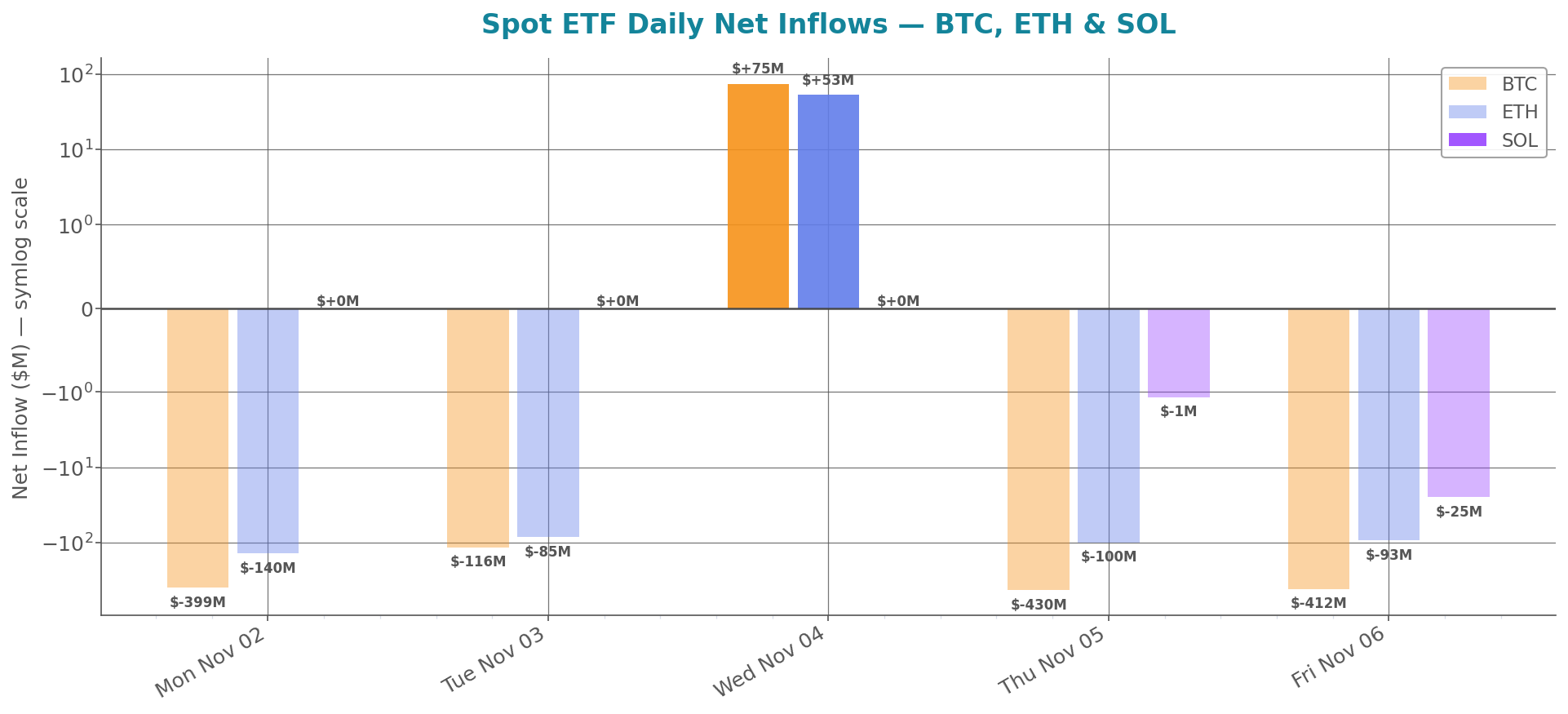
| BTC Spot ETF | $-1,281.7M | +$55,698.5M | $95.90B |
| ETH Spot ETF | $-365.3M | +$11,922.4M | $12.84B |
| SOL Spot ETF | $-26.3M | +$1,442.4M | $1.31B |
Spot ETF Daily Flows — BTC, ETH & SOL
Cost Basis Distribution & Liquidation Exposure
BTC
ANALYST INTERPRETATION — BTC
1. Positioning & Derivatives Read
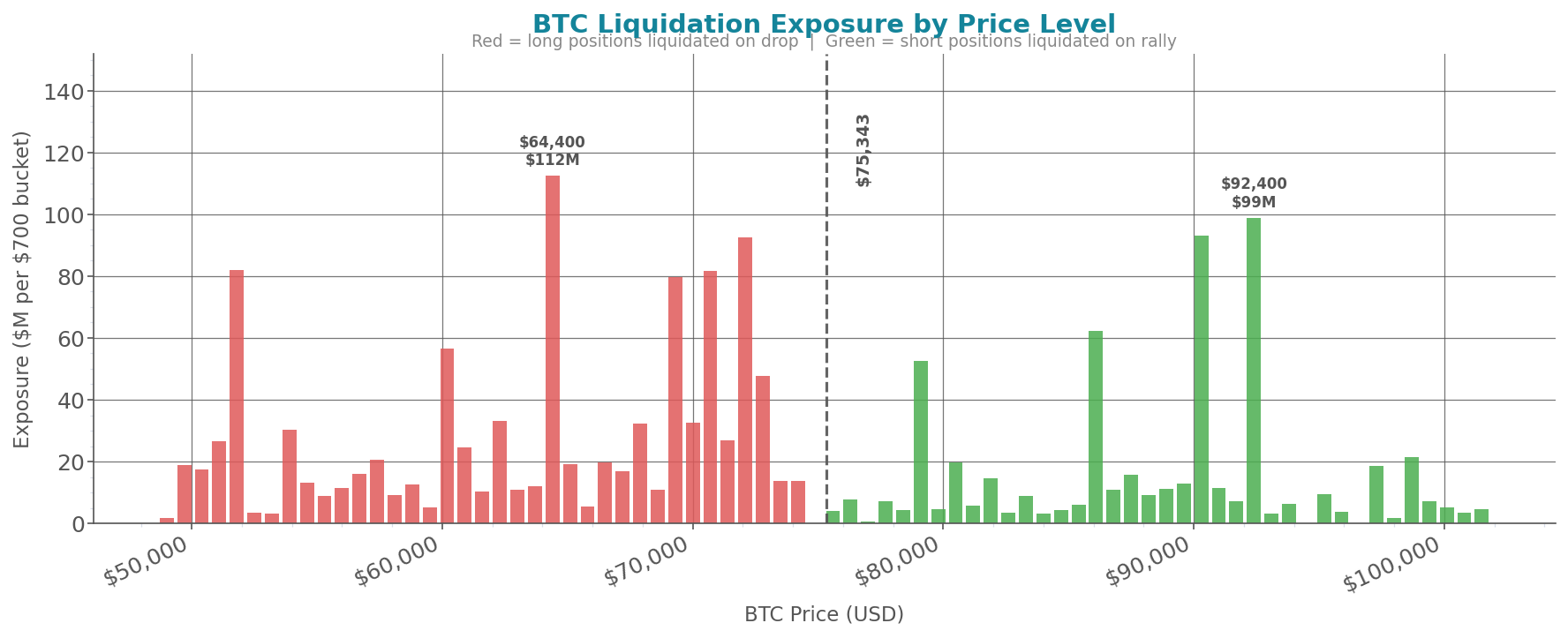
BTC perpetual futures liquidations show the damage was concentrated in longs: Glassnode recorded $494M of BTC perp longs liquidated and $220M of BTC perp shorts liquidated over the week, with the week-total long/short liquidation ratio at 2.25. From the Nov 02 close to Nov 09, BTC fell 4.94%, and the realised BTC perp liquidation split shows long positioning absorbed the larger forced unwind. BTC ETF flows reinforced the pressure, with BTC funds recording a $1,282M weekly net outflow from Mon Nov 02 to Fri Nov 06 against $95.9B of AUM. BTC long stress was still present at the end of the period, with Sunday Nov 08 recording $176M of BTC perp longs liquidated versus $8M of BTC perp shorts liquidated. BTC is long-side over-extended into next week: within 10% of BTC spot, the LONG side is the more exposed one, with $429M of longs below versus $124M of shorts above, so the larger cascade risk is below spot.
2. Key Risks & Levels for Next Week
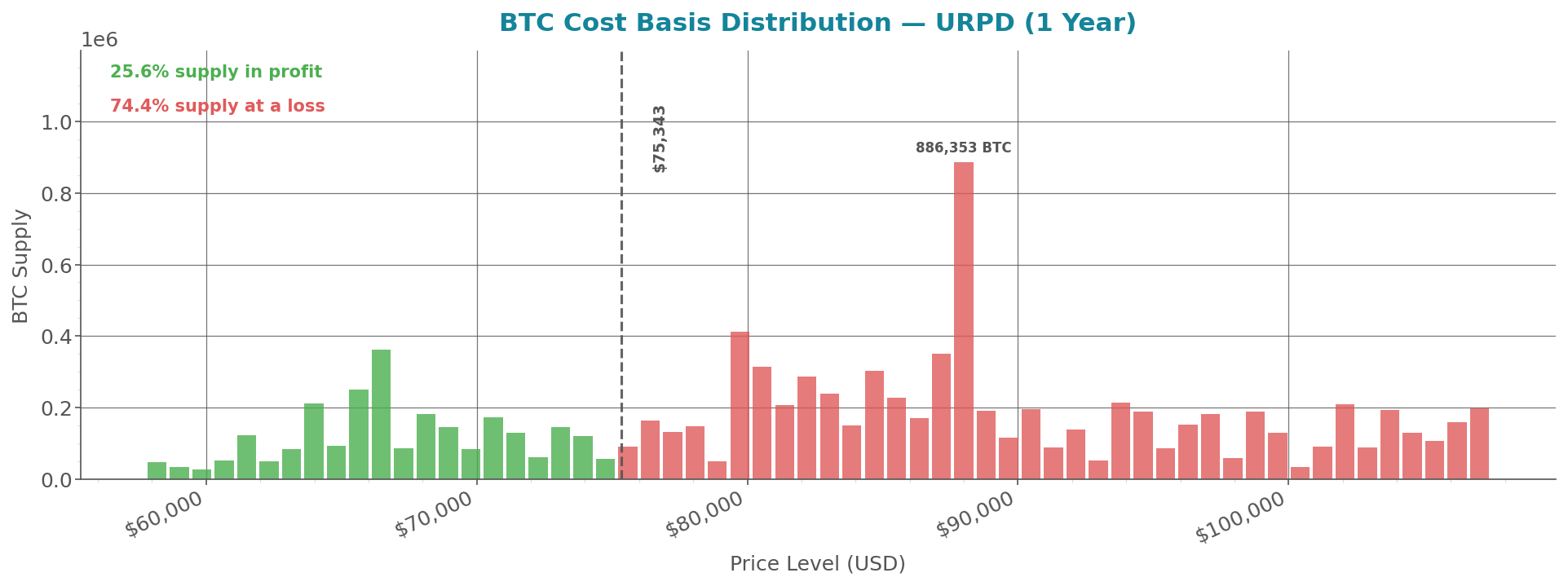
Long Liquidation Cascade: BTC spot at $75,343 sits above the nearest meaningful downside liquidation bands at $72,800, where $47.6M of longs sit, and $72,100, where $92.6M of longs sit. BTC has larger downside cascade risk below spot because $429M of longs sit within 10% of BTC spot, and the first major cost-basis support below is $68,313 with 134,435 BTC held there. Watch BTC spot volume rising into weakness, BTC ETF flows staying negative, and BTC perp long-liquidation rates accelerating before the $72,100 band is fully cleared.
Cost-Basis Air Pocket: BTC cost-basis support gets heavier at $66,305, where 207,209 BTC are held, but the path toward that area runs through BTC long liquidation bands at $70,700 with $81.8M of longs and $69,300 with $79.8M of longs. BTC downside risk becomes more mechanical if forced selling reaches those bands before cost-basis demand absorbs supply. Watch BTC spot volume expand on down-ticks and BTC perp funding pressure line up with rising long liquidations.
Short Squeeze Into Overhead Supply: BTC upside risk starts at $79,100, where $52.6M of shorts sit, then runs into BTC cost-basis resistance at $79,859 with 273,775 BTC and $81,365 with 207,650 BTC. BTC short exposure above spot is smaller than long exposure below spot, with $124M of shorts within 10% of BTC spot, so an upside squeeze needs ETF flow support and spot absorption through the overhead supply. Watch BTC ETF flows flip positive and BTC spot volume rise into the $79,859 cost-basis cluster while BTC perp short-liquidation rates accelerate.
ETH
ANALYST INTERPRETATION — ETH
1. Positioning & Derivatives Read
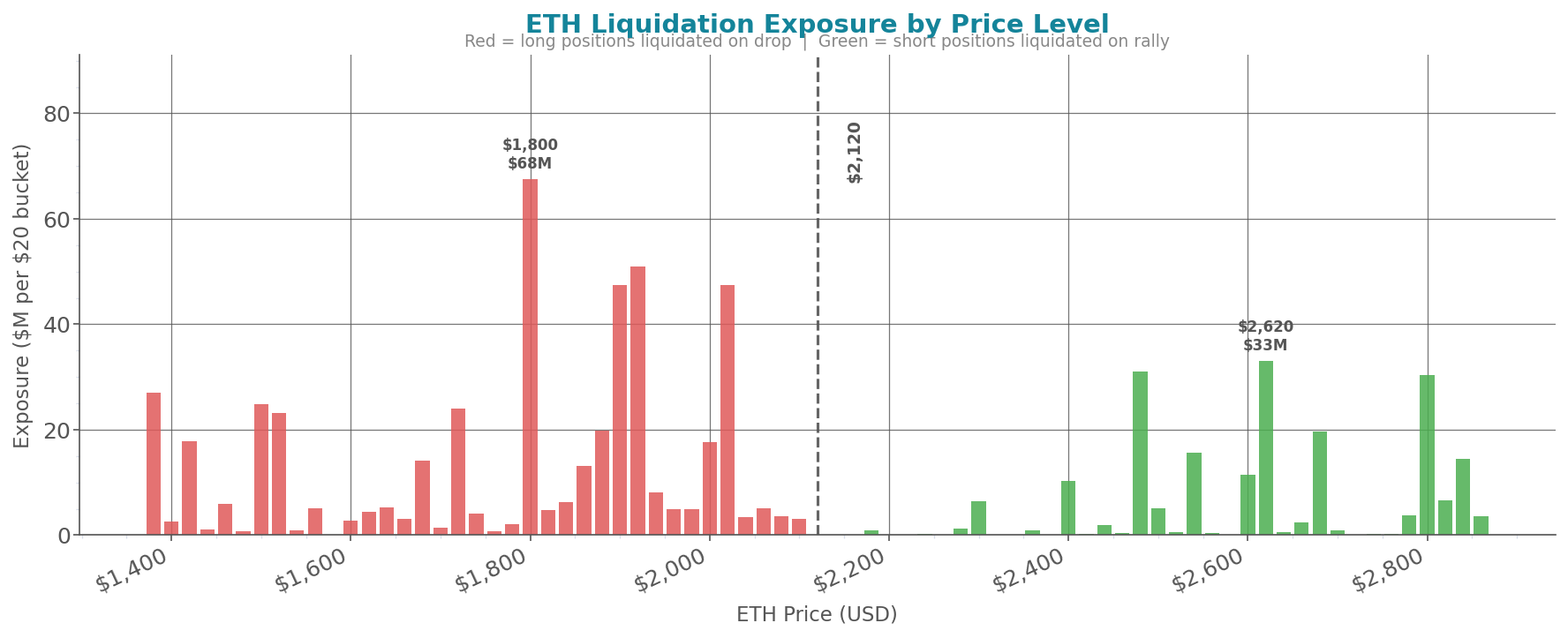
Glassnode recorded $477M of ETH perp longs liquidated and $149M of ETH perp shorts liquidated this week, with the week-total long/short liquidation ratio at 3.20. ETH perp stress was most concentrated on Sunday Nov 08, when $284M of total ETH perp liquidations and the last-day split reached $268M of longs versus $16M of shorts, with a 17.01 long/short ratio. ETH spot fell 7.32% over the crypto week from the Nov 02 close to the Nov 09 close, so the realised damage was clearly borne by levered longs rather than shorts. ETH ETF flows also leaned risk-off, with $365M of net outflows for Mon Nov 02 to Fri Nov 06, leaving cumulative ETF flows at $11.9B and AUM at $12.8B. ETH remains over-extended rather than under-extended, and the long side is more exposed going into next week because the on chain levels block shows $150M of longs below ETH spot within 10% versus $9M of shorts above.
2. Key Risks & Levels for Next Week
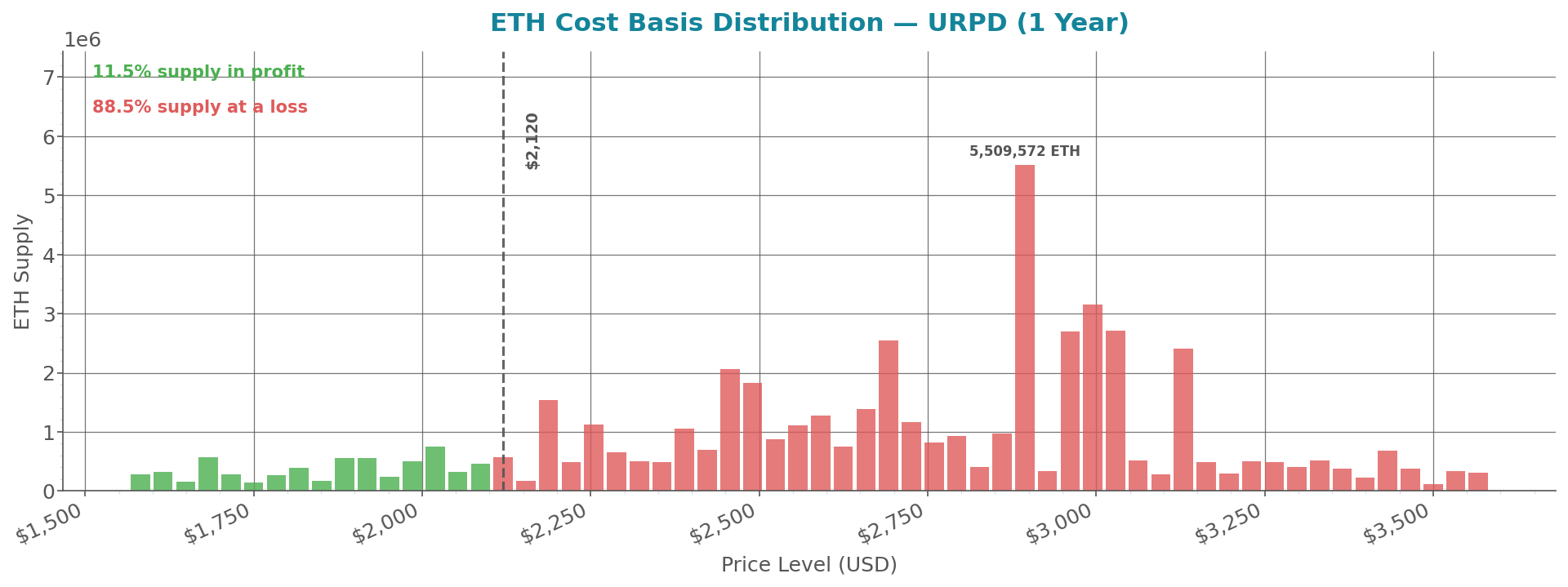
Near downside long cascade: For ETH, $2,020 is the first major long-liquidation level below spot, with $47.4M of longs exposed there, and it sits just below the $2,034 and $2,014 cost-basis clusters that hold 338,405 ETH and 417,124 ETH. The risk is that ETF outflows continue while ETH spot volume rises into those cost-basis bands and the perp long liquidation rate accelerates before price reaches the liquidation pocket.
Deeper flush zone: For ETH, $1,920 and $1,900 carry $51.0M and $47.5M of long liquidation exposure, and $1,800 carries $67.6M of long liquidation exposure. That zone matters because the first failed support response below the $2,014 cost-basis cluster leaves ETH longs facing a denser liquidation stack rather than a single isolated level. The signal that this risk is playing out is faster ETH perp long liquidation prints alongside heavier spot volume and no offset from positive ETF flows.
Short squeeze into overhead supply: For ETH, $2,280 and $2,300 are the nearest short-liquidation levels above spot, but the exposure is only $1.3M and $6.4M of shorts, so the first upside squeeze band is thin. The larger ETH test sits higher, where $2,707 holds 1,950,811 ETH at cost basis and $2,920 carries $64.3M of short liquidation exposure. The signal for this risk is ETF flows turning positive while ETH perp short liquidations accelerate before spot volume reaches the $2,707 supply cluster.
On-Chain Signals — Bitcoin
| Signal | Week-End | Week Chg | Reading |
|---|---|---|---|
| MVRV Ratio | 1.411 | -2.5% | Fair value zone |
| NUPL | 0.301 | -4.0% | Optimism |
| Exch. Net Flow (week total) | +1,219.8 BTC | +47,307.2 BTC | Net inflows — distribution |
| Exchange Balance (USD) | $256.90B | -2.4% | |
| Perp Funding Rate | +0.00600% | -0.00390pts | Near-neutral |
| Perp Open Interest | $34.46B | -3.9% | |
| 1M Implied Vol | 38.7% | +1.8pts | Low vol environment |
| 25Δ Put/Call Skew | 9.8% | -2.4pts | Slight downside bias (puts bid) |
| Realized Vol (1W) | 49.9% | +18.8pts | Elevated |
| DVOL Index | 41 | +4.3% | |
| Accumulation Balance | 1,946,667 BTC | -0.3% | |
| Supply Held ≥100k BTC | 711,278 BTC | +2.3% | |
| Net Realized P/L (week total) | -$1,454.4M | -$413.4M | Coins moved at a loss |
Amber rows deviate >1.5σ from prior 4-week baseline • data as of 2026-11-08
Notable — Accumulation Balance: 11.6σ below 4-week baseline
Notable — Realized Vol (1W): 8.1σ above 4-week baseline
Cycle metrics cooled: MVRV fell 2.5% to 1.411 and NUPL dropped 4.0% to 0.301, indicating declining but still positive aggregate unrealized profits. Derivatives positioning became less leveraged and more defensive: funding eased to +0.00600%, perpetual open interest fell 3.9% to $34.46B, while 1M implied volatility rose to 38.7%, realized volatility reached 49.9%, DVOL climbed to 41, and skew remained put-bid at 9.8%. On-chain indicators point to mounting stress: accumulation balance stood 11.6 standard deviations below baseline, MVRV was 3.1 standard deviations below its reference level, and net realized losses reached $1.45B, even as supply held by entities with at least 100k BTC increased 2.3%. Together, the indicators suggest weakening profitability, reduced speculative leverage and growing downside-risk concerns, although the large-holder supply increase complicates the distribution narrative.
Weekly Market Wrap
Democrats won control of both chambers of Congress, making the midterm sweep the week's defining political event for markets. From the October 30 close to November 6, the S&P 500 fell 2.68%, the Nasdaq fell 3.37%, the Dow Jones fell 0.94%, and the VIX rose 6.22 points. Markets initially rallied after the election result, but Thursday's sharp technology and semiconductor selloff erased those gains as investors reassessed the implications of tighter regulatory scrutiny for technology and AI infrastructure. Stronger labor data also influenced rate expectations: the US economy added 165,000 jobs in October, while unemployment edged down to 4.1%, reinforcing expectations of another Federal Reserve rate increase.
Treasuries rallied during the week, with the 10-year yield declining approximately 7-8 basis points. The dollar index gained 0.41%, gold gained 4.51%, and WTI crude fell 12.76%, as hopes of US-Iran de-escalation reduced the geopolitical risk premium in oil. Within US equities, Technology fell 8.23% and Energy fell 12.00%, while Communication Services gained 4.89% and Financials gained 1.15%. Nvidia also suffered a substantial weekly decline amid the technology selloff.
Crypto markets faced a combination of security fallout, regulatory developments and institutional outflows. US spot ETFs recorded approximately $1.282 billion in Bitcoin outflows, $365 million in Ether outflows and $26 million in Solana outflows between November 2 and 6. The Binance breach remained the industry's defining security event: the FBI attributed the attack to North Korea, which denied involvement, while Binance described how fake recruitment activity, compromised software and an internal AI tool were used to access its systems. South Korean authorities reviewed exchange security and cold-storage arrangements, while Federal Reserve and OCC supervisors contacted US banks following the incident. Separately, FinCEN ordered US financial institutions to stop processing transfers involving MEXC Global over alleged illicit financial activity. Other developments included New Jersey's withdrawal of its Coinbase staking restriction, the CFTC's authorization of equity perpetual futures on qualifying regulated exchanges, Amundi's launch of a tokenized European equity index fund share class on Ethereum, and Russia's approval of regulated BTC, ETH and USDT trading from November 17.
Next week's macro focus is US inflation data and AI earnings, which could influence expectations for a December Fed rate increase and the outlook for technology valuations. In crypto, investors will monitor whether ETF redemptions persist and whether regulatory and banking-sector security measures broaden following the Binance breach. France's November 17 budget deadline and Russia's November 17 implementation of regulated cryptocurrency trading rules provide two additional policy milestones.